Virginia Wilson ENGED 370 Chapter 3 -Meeting the Literacy needs of Diverse Learners

Multiple factors contribute to the diverse nature of today’s classrooms:

  • Linguistic Diversity: the language in which the student feels most comfortable communicating is not the language of instruction in the school.
  • Cultural Diversity: The student’s home, family, socioeconomic group, or culture differs from the predominant (often middle-class) culture of the school.
  • Cognitive and academic Diversity: The child learns at a pace or in a style different from that expected at the school.
  • Socioeconomic Diversity: students who come from areas of poverty that may not have access to books may be at risk of failing.

In addition to ELL’s learning a second language, they need to learn complex content with academic texts, as well as critical literacy skills. They need to be able to synthesize, infer, analyze, criticize, and compare and contrast complex text.

Students benefit from opportunities to connect what they know about literacy in their primary language to their new language.

Translanguaging: a view of the English language learning that is characterized by speakers moving from one language (for example, English) to other language when the communicate. This LOTE’s (languages other than English) is based on the belief that language is not something that a child simply “has,” but rather reflects ways to communicate based on one’s purpose, audience, and social context.

  • The social context for learning a second language must be a setting in which students feel accepted and comfortable.
  • Students in small groups and pairs should have natural opportunities for meaning-making and authentic communication.
  • Students need time to listen and process without the pressure of oral and written production. They are often rehearsing and creating systems while silent.

Instructional Strategies for Students Speaking Diverse Languages

  • Include environmental print from the child’s first language in the classroom. Label objects in the first language and English so that everyone is learning a second language.
  • Make sure that the classroom and school libraries have books in languages other than English as well as books written in English representing the cultures of the children.
  • Encourage children to bring in and share artifacts, music, dance, and food from their cultures, and encourage their parents to participate in selecting artifacts.
  • Help children publish and share their writing in their first language.
  • Enlist the help of bilingual aids – other students, parents, teacher aides, or community volunteers.
  • Use commercial or student-produced videos and computer software to support language learning and improve self-esteem.
  • Help ELL’s find support on the Internet.
  • Connect with the families.

Instructional Conversations take place when teachers facilitate student’s prior knowledge and experience about a topic, build on the student’s backgrounds, engage in extensive discussion, and guide understanding. Teachers also scaffold learning rather than expect yes or no answers.

Response Protocols are ways teachers can engage ELL’s to elaborate on their responses. For example, asking the student if they can tell your more about their one worded answer.

Dialects are variations of the same language spoken by members of a specific area, region, or community. They differences are generally characterized by distinctive sounds, pronunciations of words, grammar usage, and vocabulary. Regional dialects primarily differ in the pronunciation of vowels, while social dialects are typically characterized by differences in consonant sounds.

Accents are simply linguistic variations in the pronunciations of sounds; the grammar remains standard.

Instructional Beliefs about Cultural Diversity:

  1. Contributions approach: focuses on holidays and festivities that are celebrated by a particular culture
  2. Additive Approach: focuses on thematic units about different cultures that are integrated into the curriculum
  3. Transformative Approach: is more social in that students read and discuss various cultural perspectives
  4. Social Action Approach: focuses on projects that are culturally driven.

Instructional Strategies for Culturally Diverse Students:

  1. Determining Cultural Expectations
  2. Background Knowledge and Motivation
  3. Using Culturally responsive read-alouds
  4. Choosing Quality Multicultural Literature
  5. Fostering ethnic, national, and global identification
  6. Technology-enhanced instruction

Beliefs about academic and cognitive diversity are often grounded in definitions, categories, and labels. ex. disabilities characterized as low-incidence include hearing and visual impairments, autism, and developmental delay. High-incidence disabilities include significant learning difficulties more specifically related to language arts and mathematical skills.

Public Law 94-142, The Education for All Handicapped Children Act passed in 1975 is based on several principles that remain in effect today. Ex. evaluation procedures must not be discriminatory, all children are entitled to a free and appropriate education, and individualized education program (IEP) must be designed for all children with disabilities.

The Individuals with Disabilities Education Act (IDEA) 2004: added “special education teachers must be highly qualified” and the states must consider a child’s response to scientifically based interventions or alternative research procedures for identifying students with specific learning disabilities. These lay the groundword for Response to Intervention (RTI).

Dyslexia is defined by the International Dyslexia Association (IDA) as a specific reading disability in which individuals have difficulty in processing the phonological components of language.

Exceptional Students by definition also include those identified as gifted or talented, although they are not included in the IDEA legislation. Giftedness is defined as having an abundant talent in any of the seven intelligences.

Instructional Principles for Academic and Cognitive Diversity (effective literacy program include instruction in phonemic awareness, phonics, vocabulary, comprehension, and fluency) In essence, teachers should:

  1. Assess students regularly, and focus instruction on critical literacy strengths and weaknesses
  2. Use authentic learning experiences and provide students with multiple opportunities to make connections
  3. Use students’ interests as a focus of instruction to capture meaningful experiences with text
  4. Provide students with positive feedback no matter how small their steps are toward progress
  5. Engage parents in the learning process, and keep them informed of their students’ growth

Inclusion means that children with special needs are included in the regular classroom and receive assistance from the regular education teacher as well as the special education teacher. This allows the students to experience instruction that focuses on their strengths and to have more opportunities to set higher goals for themselves.

Curriculum compacting is one way to provide instruction for gifted students. Typically teachers first examine the curriculum and identify content, objectives, and outcomes. Next, students who are identified as gifted are assessed on their knowledge and skills based on the teacher’s objectives for the lesson, the theme, or the unit. Subsequently, when a student indicates sufficient mastery of the content, the teacher and student collaborate on ways to enrich student knowledge by deciding on alternative accelerated avenues of learning.

Differentiated Instruction is based on assessing student’s needs on a regular basis, implementing multiple approaches to learning, and blending whole class, small group, and individual instruction.

Multi-sensory Phonics Strategies: For students who struggle with the phonological components of reading, such as blending sounds and segmenting words into phonemes, engaging them in visual, auditory, kinesthetic, and tactile strategies is an effective way to teach phonemic awareness and phonics.

  • Finger tapping is a kinesthetic strategy.
  • Tracing is a tactile activity.
  • Auditory activities incorporate rhyming games, poetry, and read aloud books.
  • Visual supports for learning include flash cards, word walls, labels of objects in the classroom, environmental print, and big books.

Inquiry Learning is a classroom approach for teaching math and science. It can challenge gifted students in literacy learning, as well as those with special needs.
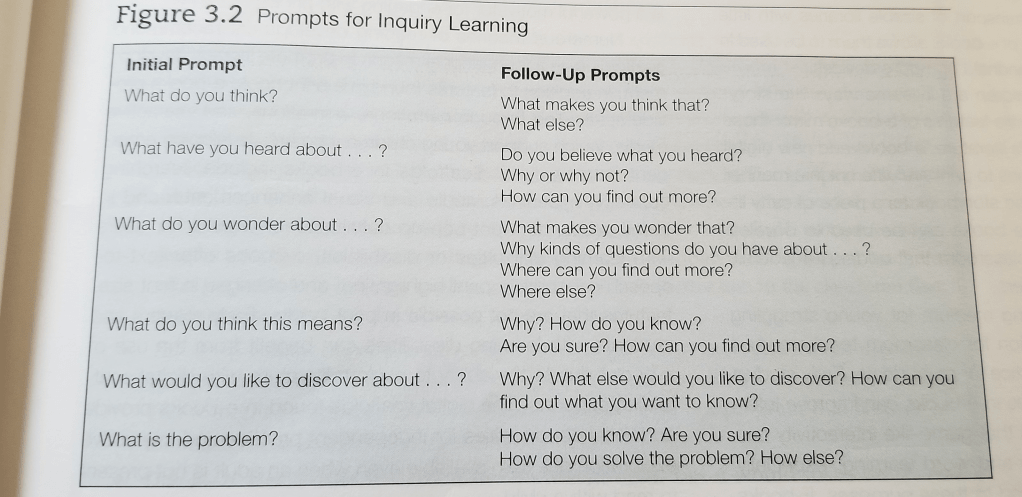
For Classroom Application of this chapter I really wanted to look into using prompts to assist students with further answering questions and deeper thinking. Generally, you do get a one or two word answer but I want students to start working on deeper meaning. Depending on my class size I think it would be fun to put students into small groups and let each of them read a selected passage from a book. I would have a list of “initial questions” that they would ask a classmate. Then once they answered I would have a list of “follow-up questions” for them to redirect at that classmate. I think it would be a fun interactive way to get them thinking deeper about the material we read. Then each group could compile a few of their deeper thinking outcomes to share with the entire class.
ENG ED 370 – Virginia Wilson Ch.2 Approaches to Reading Instruction and Running Records

Running Records are one part of a 3 part process to place students in instructionally appropriate level texts. It also lets you know if you need to move a student up a level or not. They are most often used at the earlier stages of reading to monitor reading behavior and progress.

Part 1 – Use the 3 part assessment right away at the beginning of the school year to place students with appropriate texts. (Levels aa-J)

Assessment schedule: Do more frequently if not at expected rate for reading.

  1. Early Emergent Readers (Levels aa-C) 2-4 weeks
  2. Emergent Readers (Levels D-J) 4-6 weeks
  3. Early Fluent Readers (Levels K-P) 6-8 weeks
  4. Fluent Readers (Levels Q-Z) 8-10 weeks

Taking a Running Record:

  • Select a benchmark passage/book that approximates students level. Explain they will read aloud while I observe
  • Be close to student so I can watch students hand/eye finger movements
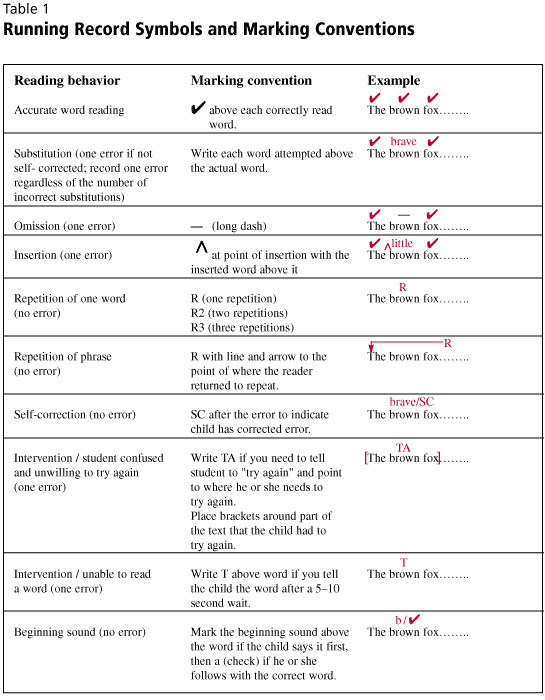
  • While student reads, check appropriate symbols and markings on running record. Put a checkmark above words correctly read. IF something is read incorrectly, record what was said.
  • IF the student is reading too fast/slow have them pause until I catch up.
  • Pay attention to the readers behavior. Are they using meaning (M), Structural (S), and visual (V) cues to read words and gather meaning?
  • Keep my mouth shut. Don’t talk unless I have too. Wait 5-10 seconds if student is stuck prior to telling them the word, explain it, then say try again.
Running Record Symbols and Marking Conventions

Marking a Running Record: Terms used when marking a running record –

  • Errors (E): tallied during the reading – word substitutions, omits, inserts, has to be told, mispronounces a word.
  • Self-correction (SC): when a child realizes his or her error and corrects it. Not scored as an error.
  • Meaning (M): When a child takes cue to make sense of text by thinking about the background, info from pictures, or the meaning of a sentence. These cues assist in the reading of a word or phrase.
  • Structure(S): refers to syntax. implicit knowledge of structure helps the reader know if what they read sounds correct.
  • Visual (V): relates to the letters in a work and the word itself. A reader uses visual info when they study sound, word length, familiar word chunks and so on.

Two-Step Process:

  1. Mark the text on the running record form as the student reads the passage or book. Record their reading behavior.
  2. Fill in the boxes to the right of the lines of text marked. Begin by looking at any errors in the first line. See if there were any self-corrections. Mark those in the second box to the right of the line. Next determine whether the errors and self-corrections were made as a result of meaning, structure, or visual cueing. Write MSV in each box for error and a self-correction made and circle the appropriate letter for the cue used by the student.
  3. Use step 2 to total errors and self-corrections. Then calculate the student’s error rate, accuracy rate, and self-correction rate.
Sample Running Record

Scoring and Analyzing a Running Record: The information gathered while doing a running record is used to determine error, accuracy, and self-correction rates.

Qualitative analysis is used to make the observations that give us the MSV and along with fluency, intonation, and phrasing.

Error Rate: Total Words/Total Errors = Error Rate (ex. 99/12 = 12.38 or 12. ratio is 1:12)

Accuracy Rate: Total Words Read – Total Errors x 100 = Accuracy Rate (99-8)/99×100 = 91/99×100 = .919 x 100 = 91.9 or 92% accuracy rate

Accuracy Rate Chart:

  • Independent (Easy enough for independent reading 95-100%)
  • Instructional (Instructional level for use in leveled reading session 90-94%)
  • Frustrational (Too difficult and will frustrate the reader 89% below)

Self-Correction Rate: (Number of errors + number of corrections / number of self-corrections = Self-Correction Rate) (ex. 8+3/3 = 11/3 = 3.666 or 4 rounded. 1:4 ratio, the child self-corrects 1 of every 4 errors.

Parts 2 &3 of 3-step assessment process:

2. Use retelling rubrics to identify strengths and weaknesses student may have comprehending texts; including analysis of text structures. Benchmark books also have multiple-choice comprehension quizzes and master keys to check strengths and weaknesses.

Scores

Running RecordQuick Check Comprehension QuizAction
95% +100%Advance Student a Level
95% +80%Instruct at this Level
95% +<80%Lower a Level, Assess Again
90-94%80-100%Instruct at this Level
90-94%<80%Lower a Level, Assess Again
<90%N/ALower a Level, Assess Again

Use Benchmark WOWzers to reward students reading progress.

Through my beliefs about reading, I will often mirror units of language for instructional purposes. The smallest units of written language are letters, and the largest is the text itself. Included are paragraphs, sentences, words and lettes.

Curriculum: reflects what teachers and students do as they engage in classroom activity. This curriculum will be affected in 5 ways by a teachers beliefs about literacy and the decisions he or she makes-

  1. The instructional objectives or target the teacher emphasizes for the classroom literacy program.
  2. the materials the teacher selects and uses for instruction
  3. the learning environment the teacher perceives as most conducive to children’s development as readers and writers
  4. The practices, approaches, and instructional strategies the teacher uses to teach reading and writing
  5. the kinds of assessment the teacher perceives are best to evaluate literacy learning

Whole Language: a belief system that challenged the bottom-up perspective, was a progressive, child-centered movement that took root in the 60s. Since some words have irregularities, (ex shoe, vs foe, doe, toe) it was found to be better to focus on the whole word.

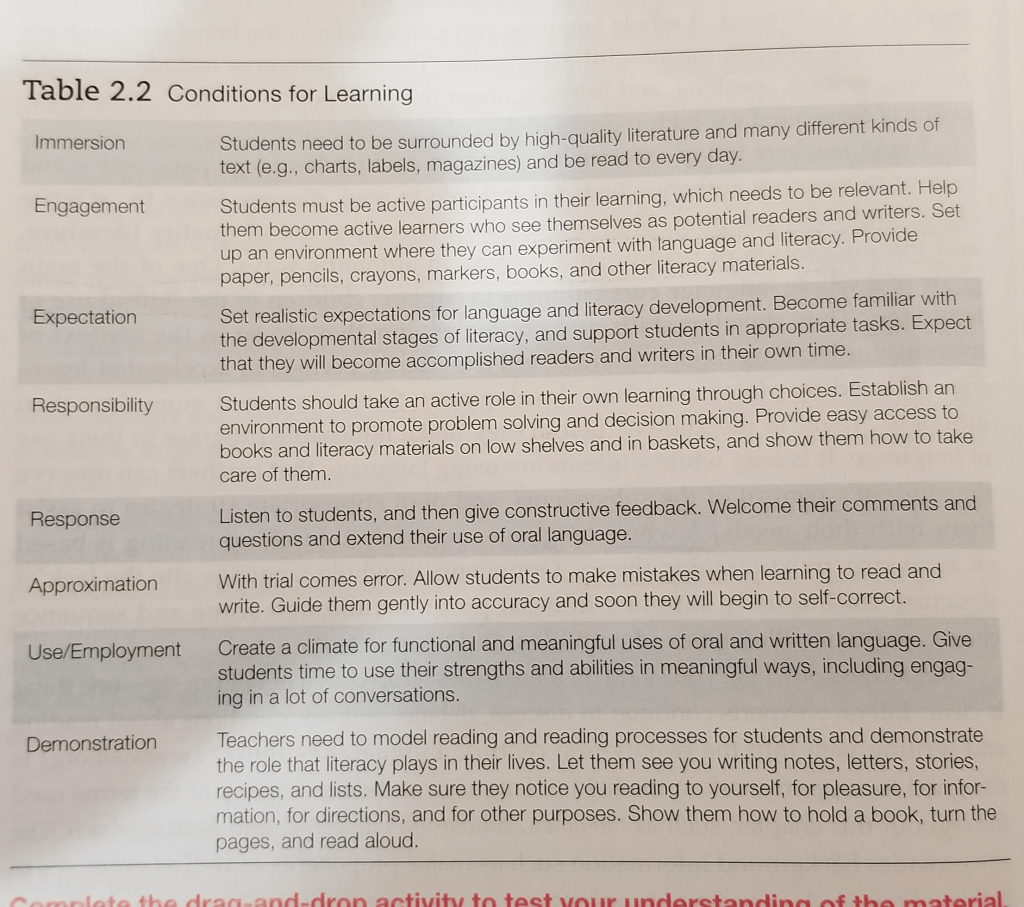
Conditions for Learning:

Different Instructional Approaches:

  1. Language-Experience Approach: includes planned and continuous activities such as individual and group dictated stories, the building of word banks of known words, creative writing activities, oral reading of prose and poetry by teacher and students, directed reading-thinking lessons, the investigation of interests using multiple materials, and keeping records of student progress. The main feature is that it embraces the natural language of children and uses their background experiences as the basis for learning to read.
  2. Literature-Based Instruction Approach: accommodate individual student differences in reading abilities and at the same time focus on meaning, interest, and enjoyment. In literature-based instruction, teachers encourage their students to select their own trade books for independent reading. (Teachers often hold conferences with individual students to ask questions about what they are reading, to make predictions, to discuss difficulties, or share interesting facts.)
  3. Technology-based Instruction: incorporates technology into the ways we locate, communicate, and disseminate information. Also changes our approach of how we read and write and become literate. Students have opportunities to videoconference with authors or other students, create video clips, movies, blogs, e-books, and online collaboration documents. (traditional basal packages now include ebooks that allow students to respond to questions, record verbal responses, highlight text, or take notes online)
  4. Individualizing Instruction: providing differentiated instruction to students. Two variations found today -(1)- individualized procedures are one part of the total program (ex. one day a week) or -(2)- parts of individualized reading are integrated into another reading approach (ex. self-selection during free reading). It really is a process of personalizing teaching to provide instruction that recognizes and responds to the unique learning needs of each child.
  5. The Integrate Approach: the best parts of all the approaches (included phonics, linguistic readers, basal programs, initial teaching alphabet, literature-based reading, language experience, and various grouping schemes and combinations of instruction.)

Explicit Strategy Instruction: directly teaching students what they need to know and providing opportunities for practice until the student applies the skill independently.

Instructional Scaffolding: the way teachers consistently check back in on students to see where more knowledge or practice needs to be applied prior to taking a step to the next level. This is done through formal and informal assessments.

Application: I would absolutely use an integrated approach with my students for reading. I think pulling from all the approaches to find what works best for each of them. I am a huge fan of using technology for teaching, and especially right now with COVID, it would be fun to let students read a book on their tablets. Then they could jot down some notes about the book or pin pages and we could bring it up on the projector so we could all talk about the different aspects of the book and what they read. Students who struggled could have a “help” button set up so it would play the word for them if they didn’t know it or couldn’t sound it out. I of course would also be walking around to assist. But I think it would be a fun way to do a group chat and incorporate in technology into literature.

ENGED 370 – Virginia Wilson Chapter 1 – Knowledge and Beliefs about Reading

Belief System: What teachers believe about reading and learning to read is closely related to what they know about literacy learning and the teaching of literacy. Literacy learning can be done through:

  1. Personal Experiences – past and present as readers and writers
  2. Practical Experiences and knowledge of their craft as they work with and learn from students
  3. Professional study that allows them to develop and extend their knowledge base about teaching and learning literacy

Intertextuality: is a word used by literary theorists to describe the connections that exist within and between texts.

Systematic Instructional Approach: includes direct teaching and a logical instructional sequence. ex. (teaching letter-sound relationships in a direct and systematic manner but relying more on explicit instruction – make it a practice to model skills and strategies that children need to decipher unknown words, explain why it is important for students to learn the skill or strategy under study, and guide students in their acquisition of the skill or strategy.)

Transliteracy: is the ability to read, write, and interact across a range of platforms, tools and media. (Being able to use, locate, and evaluate information from a web page; participate in an online discussion; listen to a podcast; and develop a video production are examples)

Jean Piaget: his theory of constructivism provides a compelling explanatory framework for understanding the acquisition of knowledge. (Child Psychologist of the twentieth century) theorized that children do not internalize knowledge directly from the outside but construct it from inside their heads, in interaction with the environment. (we acquire knowledge by building it from the inside as we interact with people, processes, ideas, and things)

An Autobiographical narrative is a powerful tool that helps one link their personal history as a reader to instructional beliefs and practices. Teachers who engage in narrative inquiry explore mental pictures of memories, incidents, or situations in their lives so they can reflect, make connections, and understand why some decisions are made.

Practical knowledge is characterized by the beliefs, values, and attitudes that you construct about readers and writers, texts, reading and writing processes, learning to read and write, and the role of the teacher in the development of children’s literate behavior. (Field experiences and student teaching are vehicles for acquiring this knowledge)

Professional Knowledge is acquired from an ongoing study of the practice of teaching. (the books and journals teachers read, the courses and workshops they take, and the conferences they attend contribute to the vision they have of reading and learning to read)

Literacy Coach: experts in reading and learning to read that provide professional development opportunities and resources to help develop expertise in the classroom. (the main role of a reading coach is to support teacher learning. But they also develop curriculum with colleagues, make professional development presentations for teachers, model lessons, provide resources, and visit classrooms to provide feedback.)

Multidisciplinary perspectives on reading and learning to read enrich and broaden the knowledge base so that teachers are in the very best position to use their professional expertise and judgment to make instructional decisions.

The Alphabetic principle suggests that there is a correspondence between letters (graphemes), which are the basic units of writing, and sounds (phonemes).

Orthographic knowledge: skilled readers chunk words into syllables automatically, in the course of perceiving letters. They can do this because of their knowledge of likely spelling patterns, or orthographic knowledge. This knowledge is so thoroughly learned that skilled readers devote less attention to encoding and put less energy into identifying words.

Because words are the primary units of written language, helping beginners develop word-reading skill is one of the important instructional responsibilities of teachers in learning to read. Other print conventions – directionality, upper- and lowercase usage, and punctuation – all need to be considered and will affect students’ ability to form words and read accurately and fluently.

Schema Theory and Reading Comprehension – Schemata reflect the prior knowledge, experiences, conceptual understandings, attitudes, values, skills, and procedures a reader brings to a reading situation. (Students use what they already know to give meaning to new events and experiences)The more we hear, see, read, or experience new information, the more we refine and expand existing schemata withing our language system. The more schema we have, the easier it will be for us to comprehend what we are reading. They go hand in hand. When a good fit between the two occurs, schema functions in at least three ways to facilitate comprehension –

  1. First schema provides a framework that allows readers to organize text info
  2. it allows readers to make inferences about what is/going to happen in a text
  3. helps readers elaborate on the material (they engage, in cognitive activity that involves speculation, judgment, and evaluation)

Metacognition – refers to knowledge about and regulation of some form of cognitive activity. In the case of reading, it refers to:

  1. Self-knowledge: the knowledge students have about themselves as readers and learners
  2. Task-knowledge: the knowldge of reading and the strategies that are appropriate given a task at hand
  3. Self-monitoring: the ability of students to monitor reading by keeping track of how well they are comprehending

Implicit teaching: a message to a reader that the reading is supposed to make sense. Can be used to see if a child understands the context of a word in a sentence or the sentence itself. (ex. if a child provides a word other than the unfamiliar word bu preserves the meaning of the text, the teacher would be instructionally and theoretically consistent by praising the child and encouraging him to continue reading)

A teacher can make the implicit messages about reading strategies Explicit teaching by modeling, demonstrating, explaining, rationale-building, thinking aloud, and reflecting on the text.

Cognition and Language are crucial components of human development, and most children understand and use all of the basic language patterns by the time they are 6 years old.

  • Jean Piaget believed through cognitive development that children’s language acquisition is influenced by their environment, and how they explore, interpret, and give meanings to the events they experience. His belief is that the child needs to interact with immediate surroundings and to manipulate objects in order to develop.
  • Lev Vygotsky also believed that children needed to be active participants in their own learning. But he also felt that as they grew older, they began to regulate their own problem-solving activities through the mediation of egocentric speech. Basically, children carry on external dialogues with themselves which gives way to inner speech.

A pyscholinguistic view of reading combine a psychological understanding of the reading process with an understanding of how language works. (readers act on and interact with written language in an effort to make sense of a text) Readers search for and coordinate information cues from three distinct systems in written language: the graphophonemic, the syntactic, and the semantic.

  1. Graphophonemic system: relies upon the print itself in order to provide readers with a major source of information – the graphic symbols or marks on the page represent speech sounds.
  2. Syntactic system: depends on readers possessing knowledge about how language works. Syntactic information is provided by the grammatical relationships within sentence patterns. (readers use their knowledge of the meaningful arrangement of words in sentence to construct meaning from text material)
  3. Semantic system: system of language that stores the schemata that readers bring to a text in terms of background knowledge, experiences, conceptual understandings, attitudes, beliefs, and values.

Models of Reading-

  1. Bottom-up Models – assume that the process of translating print to meaning begins with the print. the process is initiated by decoding graphic symbols into sounds. The reader first identifies features of letters, then links them to letters, combines to form spelling patterns, then words, sentences, paragraphs, and text level processing.
    • Automaticity – the concept suggests that humans can attend to only one thing at a time, but may be able to process many things at once as long as no more than one requires attention.
  2. Top-down Models – assume that the process of translating print to meaning begins with the reader’s prior knowledge. The process is initiated by making predictions or educated guesses about the meaning of some unit of print.
  3. Interactive Models – assume that the process of translating print to meaning involves making use of both prior knowledge and print. The process is initiated by making predictions abut meaning and/or decoding graphic symbols .

Classroom Application: Well there was a ton of information in this chapter! I really like the idea of using a systematic instructional approach to teaching because it involves both implicit and explicit techniques in teaching. I believe that children all learn differently and if I can use both to work with my students on reading then they will have more than one way to approach a word or sentence in a book. This would lead into my techniques for teaching students to read, I would use the interactive model which would encompass both the Bottom-up method and the Top-down processing styles. When I would read from the big books in front of the classroom, I would choose books that would challenge students to use both models. I would ask questions that would in-return elicit “educated guesses” from students. And other times I would ask students to “decode” the features of the text to form letters, words, and sentences. This way I am arming my students with multiple ways to think about text and to understand its meaning.

Notes from Video on Phonological Awareness – The big picture. The broader awareness of sound. Incorporates rhyming, singing, chanting, hearing sounds, illiteration (peter piper picks peppers…) syllables (slapping them, counting them)

Phonemic Awareness – smaller category of phonological awareness. Only works with phonemes. All Auditory.

Phonics – introduces print, visuals, text, rules, patterns.

See pdf’s attached in Eng Ed 370 Folder on laptop. Three Cueing System, Phonological Awareness, and Developmental Spelling stages. Saved in Fall 2020 Folder for school.

EngEd 275- Virginia Wilson Ch. 12 Reading and Writing Across the Curriculum

Trade books are rich in narrative and informational content, and can provide a valuable compliment to most textbooks. They can be nonfiction books, picture books, fiction books and many other types of books. They are generally used in conjunction with textbooks to assist students with connecting their own lives and background knowledge to the thematic unit.

Text sets are sets of books and other reading materials on topics to use in teaching thematic units. They are carefully chosen to include different genres, a range of reading levels to meet the needs of students, and multimedia resources that present a variety of perspectives. Examples are:

  • atlases and maps
  • brochures and pamphlets
  • digital articles
  • films and videos
  • magazines
  • models and diagrams
  • newspaper articles
  • nonfiction books
  • photographs
  • poems and songs
  • primary source materials
  • reference books
  • stories
  • websites and WebQuests

Mentor Texts– teachers use stories, nonfiction books, and poems that students are familiar with to model the writer’s craft. Teachers begin by rereading a mentor text and pointing out a specific feature such as adding punch with strong verbs, writing from a different perspective, or changing the tone by placing adjectives after nouns. Then students imitate the feature in brief collaborative compositions and in their own writing.

Learning Logs used to record and react what they’re learning in social studies, science, or other content areas. basically a place to think on paper. Students can use these to discover gaps in their knowledge and to explore relationships between what they’re learning and their past experiences.

Double-entry Journals are when students divide their journal pages into two parts and write different types of information on each one. For example, important facts in one column and their reactions to the information in the other.

Quickwriting is when students write on a topic for 5 to 10 minutes letting thoughts flow from their minds to their pens without focusing on mechanics or revisions.

Collaborative books are when students work together to write. Sometimes students will each write one page for the report, or they can work together in groups to write chapters.

Essays are used for students to explain, analyze, and persuade; sometimes their topics are personal, and sometimes they address national and international issues such as gun safety, famine, and immigration. These are usually short, no more than two pages. There are also five paragraph essays, intro, body and conclusion.

Stages of Reading Process

  • Stage 1: Prereading: Used to activate and build students’ background knowledge about the topic; To introduce big ideas and technical words; Set purposes for reading; and preview the text. Activities Used:
    • KWL Charts – What I know, What I want to know, What I learned
    • Text set of books
    • Websites, videos and DVDs
    • Anticipation guides – teachers introduce a set of statements on the topic of the chapter, students agree or disagree with each statement, and then they read the assignment to see if they were right
    • Exclusion brainstorming
    • possible sentences
    • prereading plan – teachers create these to present an idea discussed in the chapter and then have students brainstorm words and ideas related to it.
    • question-answer-relationships – here students turn main headings into questions and prepare to read to find the answers to the questions or check the questions at the end of the chapter.
    • text walk
    • word walls
  • Stage 2 – Reading – Teachers ensure that students can read the assignment, assist students in identifying the big ideas and help students organize ideas and details
  • Stage 3 – Responding – teachers help students develop and refine their comprehension in this stage as they think, talk, and write about the information they’ve read by clarifying students’ misunderstandings, helping students to summarize the big ideas, and making connections to students lives.
  • Stage 4 – Exploring – teachers ask students to dig into the text during the exploring stage to focus on vocabulary, examine the text, and analyze the big ideas by having students study vocabulary words, reviewing the big ideas of the chapter, and helping students to connect the big ideas to the details.
    • Word sorts are used to emphasize the relationships among the big ideas.
    • Semantic feature analysis charts are used to classify important information. These charts are often kept to refer to them to write reports or create other projects.
  • Stage 5 – Applying – teachers support students as they apply what they’ve learned by creating projects in these ways; expand students’ knowledge about the topic, have students personalize their learning, or expecting students to share their knowledge.

The SQ4R Study Strategy – a six-step technique in which students survey, question, read, recite, relate, and review as they study a content area reading assignment.

Thematic Units are interdisciplinary units that integrate reading and writing with social studies, science and other curricular areas. Students are often involved in planning the thematic units and identifying some of the questions they want to explore and the activities that interest them.

How to Develop a Thematic Unit

  1. Determine the focus of the unit
  2. Collect a text set
  3. Coordinate textbook readings
  4. Locate digital and multimedia materials
  5. Plan instructional activities
  6. Identify minilesson topics
  7. Plan ways to differentiate instruction
  8. Brainstorm possible projects
  9. Plan for assessment

Adjusting Instruction –

  • Use visuals and manipulatives, including artifacts, videos, photographs, and models
  • Preteach big ideas and key vocabulary
  • Teach students about expository text structures
  • Practice taking notes with students
  • Use graphic organizers and other diagrams to highlight relationships among big ideas
  • Include frequent opportunities for students to talk informally about big ideas
  • Collect text sets, including picture books and online resources
  • Use a textbook as only one resource
  • Review big ideas and key vocabulary

Choosing Alternative Assessments – instead of writing an essay students can draw pictures or graphic organizers about the big ideas and add words from the word wall to label them to demonstrate their learning, or they can talk about what they’ve learned in a conference with the teacher. Instead of giving written tests, teachers can simplify the wording of the test questions and have EL’s answer them orally. Have students work in small groups for projects vs alone. Use portfolios of students work to assess achievements.

Classroom Application: I think it would be a lot of fun to incorporate a text set on immigration in the United States. It falls under Social Studies and I could find a good selection of resources from pictures, journals, books, and many others from different cultures that have immigrated here. We could study where the countries were and I could put my students in small groups to create a poster on one particular culture. Students could draw from a number of resources to complete this project, then they would tell the rest of the class about those particular immigrants and how they got the the US.

Virginia Wilson- EngEd 275 Chapter 11 – Differentiating for success

From the Video – Differentiation using cut out strips with words, meets standard: can cut out a strip of paper and identify beginning sounds of words on strip. Above: identify ending/middle sounds or write out words. Below: give a cut out of letters and let students match letters to the beginning sounds. The goal is to make an activity easier and more challenging for others. It’s NOT about giving out more work. Otherwise students will think that being smart is bad and vice versus.

Differentiated Instructions: means shaking up what goes on in the classroom so that students have multiple options for taking in information, making sense of ideas, and expressing what they learn. Thinking ahead and adding in aspects to challenge students who work above grade level, and to assist learners who may be below grade.

Characteristics of Differentiated Instruction:

  • Rigorous means that teachers provide challenging instruction that encourages students’ active engagement in learning
  • Relevant means that teachers address literacy standards to assure that students learn essential knowledge, strategies, and skills
  • Flexible means that teachers use a variety of instructional procedures and grouping techniques to support students
  • Complex means that teachers engage students in thinking deeply about books they’re reading, compositions they’re writing, and concepts they’re learning

Differentiating the Content: The content is the “what” of teaching, the literacy of knowledge, strategies, and skills that students are expected to learn at each grade level. Teachers decide how they’ll differentiate the content by assessing students’ knowledge before they begin teaching, and then they match students with the appropriate activities.

Differentiating the Process: The process is the “how” of teaching, the instruction that teachers provide, the materials they use, and the activities students are involved in to ensure that they’re successful. Teachers group students based on abilities and find materials at the appropriate level of difficulty. They make decisions about how to involve them in activities that can showcase their learning orally, written, or visual means.

Differentiating the Product: The product is the result of learning; it demonstrates what students understand and how well they can apply what they’ve learned. They can create projects such as posters, multimodal reports, board games, puppet shows, and new versions of stories.

Grouping for Instruction: Teachers use three grouping patterns: sometimes students work together as a whole class, and at other time work in small groups or individually. Small groups are used flexibly to provide a better instructional match between students and their needs. Students are generally grouped and re-grouped often according to their achievement levels. Grouping patterns: see pg. 373, figure 11-1. (Basal Readers, Literature Focus Units, Literature Circles, Reading Workshop, and Writing Workshop)

Guided Reading: Developed to use with beginning readers, but is also used with older readers, such as ELL’s and those struggling readers who need more teacher support to decode and comprehend books they’re reading, learning reading strategies, and become independent readers.

Tiered Activities: To match students’ needs, teachers create several tiered or related activities that focus on the same essential knowledge but vary in complexity. These activities are alternate ways of reaching the same goal because “one-size-fits-all” activities can’t benefit on-grade-level students, support struggling readers, and challenge advanced students. Teachers vary activities in different ways:

  • they vary them by complexity of thinking. In recall-level activities, students identify, retell, or summarize; in analysis level activities, they compare and categorize; in synthesis-level activities, students evaluate, draw conclusions, or invent.
  • they vary activities according to the level of reading materials. They use books and other print and online materials written at students’ reading level, or vary the way they share the materials with students.
  • vary through activities by the form of expression. Students are involved in visual, oral, and written expression as they complete and activity.
  • teachers decide which students will do each version of the activity.

Literacy Centers: Literacy centers contain meaningful, purposeful activities that students can work at in small groups. Students practice phonics skills at the phonics center, sort word cards at the vocabulary center, or listen to books related to a book they’re reading at the listening center. Description of centers on p. 377.

Struggling Readers: It’s crucial to identify students at risk for reading problems early so these problems can be addressed quickly, before they’re compounded.

  • Difficulty developing concepts about written language, phonemic awareness, letter names, and phoneme-grapheme correspondences
  • Slower to respond than classmates when asked to identify words
  • Behavior that deviates from school norms

Struggling Writers: Some students have difficulty developing and organizing ideas, some struggle with word choice and writing complex sentences and effective transitions and others have problems with spelling, capitalization, punctuation, and grammar skills.

High Quality Classroom Instruction: teachers use a balanced approach that combines explicit instruction in decoding, fluency, vocabulary, comprehension, and writing along with daily opportunities for students to apply what they’re learning in authentic literacy activities. They also use:

  1. Personalizing Instruction: teachers adjust their instructional programs to match students’ needs using flexible grouping, tiered activities, and respectful tasks.
  2. Using appropriate instructional materials: most teachers have plenty of books available for on-grade-readers, but sometimes finding books for struggling students is a bit more difficult. Recommendation is to use a whole class book only 25% of the time, the rest choose books that fit students reading levels.
  3. Expanding Teachers’ Expertise: Teachers continue to grow professionally during their careers through organizations, book clubs, workshops and conferences, and teacher-inquiry projects.
  4. Collaborating with Literacy Coaches: Literacy Coaches are experience teacher with special expertise in working with struggling readers and writers.

How to Address Struggling Readers problems: p. 386-387 Solutions. Some problems are: Student doesn’t understand print concepts, student cant name letters or match upper and lower case letters, Student cant manipulate speech sounds…. Plus many more. See book. too many to list.

How to Address Struggling Writers Problems: p.388-389 (solutions). Lack of ideas, organization, motivation, issues with the writing process or the composition itself. Many more, see book.

Interventions: programs to address low-achieving students’ reading and writing difficulties and accelerate their literacy learning.

Early Interventions: focus for intervention has changed to early intervention for at-risk children to eliminate the pattern of school failure that begins early and persists throughout some students’ lives.

Reading Recovery: it involves 30 minute daily one-on-one tutoring by specifically trained and supervised teachers for 12-30 weeks. it involves

  • rereading familiar books
  • independently reading the book introduced in the previous lesson
  • learning decoding and comprehension strategies
  • writing sentences
  • reading a new book with teacher support

Response to Intervention: a schoolwide initiative to identify struggling students quickly, promote high-quality classroom instruction, provide effective interventions, and increase the likelihood that students will be successful. it involves 3 tiers

  1. Screening and Prevention
  2. Early Intervention
  3. Intensive Intervention

Interventions for older students: approximately 25% of students in the upper grades are struggling readers, and they need effective classroom interventions in addition to high-quality reading instruction.

  • High-Quality Instruction – teachers provide high-quality, appropriate literacy that’s tailored to students’ needs.
  • Instructional-Level Reading Materials: teachers teach reading using books at students’ instructional level that are also appropriate for their age.
  • More time for Reading: teachers increase the amount of time students spend reading independent level books each day, and they ensure that students choose interesting books to read.

Classroom Application:

There are so many different ways that this chapter could be used in a classroom. Differentiation is so important, and I wish I had read this chapter like a month ago! Each and every lesson plan needs to be tailored to your students abilities whether high or low or meeting requirements. So finding ways to change up a plan without adding in extra work for students is key. Also, being able to assess and see if any of your students are falling behind in reading or writing skills is equally important. That is why we can and should have different levels of learning for each lesson. I really loved reading about literacy centers. I think they are just so neat, and so fun for students to be able to pick what center they want to go work in for the day. Also, it opens it up for the teacher to work individually with students or a small group of students on skills they may need to fine tune. Great chapter!! I can’t wait to use this book to set up my classroom. (I bought it because it has so much great information)

EngEd 275 – Virginia Wilson Chapter 10 – Organizing for Instruction

Strategies for Beginning Literature Circles Video :

  1. Day 1 – Teaching and Modeling, Introduce book, Introduce Roles/Jobs, Explanations of everything, table leader is in charge of giving out jobs.
  2. Days 2-3 – Review group roles, Independent student reading and work, teacher small group work with group roles, activity sheets vary with each student and their roles.
  3. Last day for the week – Review expectations again, student literature discussions take place, goal is to get them to have solid discussions and to collaborate about the pages they read.

Word Walls – where teachers write sight words or commonly used words for students to reference. I’ve seen where they have the alphabet written on the board and they put the new words they learn under the letter it begins with.

Think-aloud – a way to get a students mind thinking while they are reading. Have a set list of questions or ideas you want students to think about while reading a passage or chapter. Then stop frequently to discuss or answer some of those questions, then go back to reading. It’s teaching students to think about the story, words, composition, text, and other items while reading.

Grand Conversation – full classroom or small group discussion. Giving students a chance to talk with each other about the book or what they are reading together. Share ideas, make connections, asking clarifying questions, and reading from the text to make a point.

Guided Reading – used to teach reading to small groups of four to six students who read at the same level. Generally 20 minutes long or so. Used to develop independent readers who use strategies flexibly to decode unfamiliar words, read fluently, and comprehend what they’re reading.

Reading Strategies –

  • Self-monitoring
  • Checking predictions
  • Decoding unfamiliar words
  • Determining if a word makes sense
  • Checking that the word is appropriate in the syntax of the sentence
  • Using all sources of information
  • Chunking phrases to read more fluently

Literacy Centers in the Classroom – These centers are inviting, and students know how to work independently or cooperatively in small groups at the centers using all sorts of literacy materials, including books, online games, and digital media.

Basal Reading – Commercial Reading programs designed for each grade level. Today’s basal readers include more authentic literature selections that celebrate diverse cultures, and they emphasize an organized presentation of strategies and skills, especially phonics in the primary grades.

Components of Basal Reading – Strong skill component, teachers teach skills in a predetermined sequence, and students apply what they’re learning in textbook selections they read and the workbook assignments they complete.

  • Selections in grade-level textbooks
  • Instruction about decoding and comprehension strategies and skills
  • Workbook assignments
  • Independent reading opportunities
  • Management plan that includes flexible grouping and regular assessment

Materials used in Basal Reading Programs –

  • Textbook
  • Big Books
  • Supplemental books
  • Workbooks
  • Kits
  • Teacher’s guide
  • Home-school connections
  • Assessment System
  • Multimedia resources
  • Lesson planner

Literature Focus Units – used to teach reading through literature, using high-quality, grade-appropriate picture books and novels.

Components include –

  • students read and respond to a trade book together as a class
  • the teacher teaches minilessons on phonics, vocabulary, and comprehension using the book they’re reading
  • and students create projects to extend their understanding of the book

Steps in Developing a Literature Focus Unit –

  1. Select the Literature
  2. Set Goals on what you want students to learn
  3. Develop a Unit plan
  4. Coordinate Grouping patterns with activities
  5. Create a time schedule
  6. Assess students – planning, monitoring, evaluating and reflecting

Literature Circles – small, student-led book discussion groups that meet regularly in teh classroom. Sometimes called book clubs. The reading materials are quality books of children’s literature, including stories, poems, biographies, and other nonfiction books that children enjoy and are interested in.

Key Features of a literature circle –

  1. choice – Students make many choices in a literature circle such as, the books they will read, the roles they will play, how they will discuss the book.
  2. Literature – the books chosen should be interesting and at students reading levels
  3. Response – students meet several times during a literature circle to discuss the book. Through these discussions, students summarize their reading, make connections, learn vocabulary, and explore the author’s use of text factors.

Types of Talk during Literature Circle Discussions : Talk about the book (events or big ideas, genre, elements or patterns author used, examples of literary devices), Talk about Connections (how book connects to their lives, how it compares to another book, how it compares to a tv or movie), Talk about the Reading Process (strategies used, reading problems and how they solved them, reread sections and why they reread them, their thoughts while reading, parts they understood or misunderstood), Talk about Group Process and Social Issues (who will be the group leader, determine schedule, roles and responsibilities, draw in nonparticipating students, keep convo on topic, extend the discussion to social issues and current events).

Roles Students play in literature circles: (pg. 348)

  1. Discussion Director – guides the groups discussion and keeps it on task
  2. Passage Master – focuses on the literary merits of the book and shares memorable passages.
  3. Word Wizard – responsible for vocabulary, identifies important unfamiliar words.
  4. Connector – points out links between the book and student’s lives.
  5. Summarizer – prepares a brief summary of the reading to convey the big ideas to share with the group.
  6. Illustrator – draws a picture or diagram related to the reading. it could relate to a character, an exciting event, or a prediction.
  7. Investigator – Locates some information about the book, the author, or a related topic to share with the group. Used internet, encyclopedia or library book, interviews a person with special expertise on topic.

Series of activities in literature circles:

  1. Prereading – teachers give book talks, then students choose books to read, form groups and get ready to read by making schedules and choosing roles
  2. Reading – students read the book independently or with a partner, and prepare for the group meeting.
  3. Responding – students talk about the book and take responsibility to come to the discussion prepared to participate actively
  4. Exploring – teachers teach minilessons during which students rehearse literature circle procedures, learn comprehension strategies, and examine text factors
  5. Applying – students give brief presentations to the class about they books they’ve read

Shared Reading – students take turns reading or read aloud to one another.

Reading and Writing workshops – this approach involves three key characteristics, time, choice and response.

  1. Students have large chunks of time and the opportunity to read and write. They become the core of the curriculum
  2. students assume ownership of their learning through self-selection of books they read and their topics for writing.
  3. Students respond to books they’re reading in reading logs that they share during conferences with the teacher. They also do book talks to share books they’ve finished reading with classmates. In a writing workshop students share with classmates rough drafts of books and other compositions they’re writing.

The Goldilocks Strategy for choosing books – Three categories of books, “Too Easy”, “Just Right”, and “Too Hard”.

“Too Easy” Books

  • the books is short
  • the print is big
  • you have read the book before
  • you know all the words in the book
  • the book has a lot of pictures
  • you are an expert on this topic

“Just Right” books

  • the book looks interesting
  • you can decode most of the words
  • your teacher has read this book aloud to you
  • you have read other books by this author
  • there’s someone to give you help if you need it
  • you know something about this topic

“Too Hard” books

  • the book is long
  • the print is small
  • there aren’t many pictures in the book
  • there are a lot of word that you cant decode
  • there’s no on to help you read this book
  • you don’t know much about this topic

Minilessons – short lessons to assist with a topic, or given to a small group. helps with students who are younger and don’t have high attention spans. Also great for sharing a small bit of information that doesn’t overwhelm students.

Responses in Reading Workshops:

  1. Immersion Responses – students indicate whether the book is making sense to them, They draw inferences abut characters, offer predictions, ask questions, or discuss confusions.
  2. Involvement Responses – students show that they’re personally involved with a character, often giving advice or judging a character’s actions. They reveal their own involvement in the story as they express satisfaction with how the story is developing.
  3. Literary Connections – students make connections and evaluate the book. They offer opinions, sometimes saying, “I liked…” or “I didn’t like…” and compare the book to others they’ve read.

Sustained Silent Reading (SSR) – is an independent reading time set aside during the school day for students in one class or the entire school to silently read self-selected books.

Managing a workshop classroom – Takes time!! Beginning the first day of the school year, teachers establish the workshop environment in their classroom. They provide time for students to read and write and teach them how to respond to books and to their classmates’ writing. Through their interactions with students, the respect they show to students, and the way they model reading and writing, teachers establish the classroom as a community of learners.

Classroom Application:

I think as a new teacher, I would be more interested in using a basal reading program just because I want to see how things flow with my first class. But after I get more comfortable in my position, I would love to use literature circles. I remember participating in them when I was in school and it was a lot of fun. I think it is good for students to take on different roles, and learn to step outside of the box where the teacher tells you where, when, and how to do everything. This would be a great setup for students in the second and third grade because they are really developing their reading skills at that age and I could see the benefits of using a literature circle.

Virginia Wilson EngEd 275 – Chapter 9: Promoting Comprehension: Text Factors

Video Summaries:

Myths, Fables, & Folktales

  1. Myth: a short story that explains why something is the way it is. Generally has Gods/Goddesses, Teaches a lesson, has magic, comes from different cultures.
  2. Fable: a short story used to teach a moral or lesson, often with animals as the main characters.
  3. Folktale: short stories that have been told orally from generation to generation. Generally have no known author, 3 characters, 3 tasks, 3 events. Once upon a time, or A long, long, time ago…

The Grasshopper and the Ants: Aesops’ Fable: Had pop up vocabulary words during story. Moral of the story is its important to prepare for the future as the ants were preparing food for winter. Work today for what you’ll need tomorrow.

Fantasy breaks the Rules of what we know: Imagination, authors are known, characters generally go on a journey or quest, unreal things become real through magic. Harry Potter!!

Science Fiction Genre: unreal things that could be real things in our far future. Technology, discovery, and science generally guide these stories to take you to another time. Could be past, could be future. World of possibilities. Authors are known, could happen in real-life in the future.

Realistic Fiction: Juney B. Jones stories. characters are made up and imagined but they could be real. They deal with real-time problems, in real-time settings that we could imagine ourselves going through. Characters work through problems on their own.

Non-Fiction Text Features: help you make sense of what you’re reading: titles, sub-titles, table of contents, uses charts, graphs, tables, photos with captions, diagrams with labels, maps, timelines, bold & italics, glossary, index in alphabetical order.

My parents think I’m sleeping: super cute level 3 story where a young boy is in bed but doesn’t go to bed. he is thinking of all the different things around him (hairbrushes turn into teeth), Where does the color go at night etc. A first time chapter book almost.

Genres: the three broad categories of literature are stories, informational books or nonfiction, and poetry. Each can be broken down into smaller subgenres.

Text Structures: authors use text structures to organize texts and emphasize the most important ideas of the text.

Text Features: used to achieve a particular effect in their writing. such as symbolism, tone in stories, headings, and indexes, page layout for poems.

Narrative Genres:

  1. Folklore – stories began hundreds of years ago and were passed down from generation to generation by storytellers orally
    • Fables: brief tales told to point out a moral
    • Folktales: stories in which heroes demonstrate virtues to triumph over adversity
    • Myths: stories created by ancient people to explain natural phenomena
    • Legends: stories, including hero tales and tall tales, that recount the courageous deeds of people who struggled against each other or against gods and monsters.
  2. Fantasy – imaginative stories
    • Modern literary tales: stories written by modern authors that are similar to folktales.
    • Fantastic stories: imaginative stories that explore alternate realities and contain elements not found in the natural world.
    • Science Fiction: stories that explore scientific possibilities.
    • High Fantasy: Stories that focus on the conflict between good and evil and often involve quests
  3. Realistic Fiction – stories are lifelike and believable
    • Contemporary stories: stories that portray today’s society
    • Historical Stories: realistic stories set in the past

Elements of story structure: stories have unique structural elements that distinguish them from other genres such as plot, characters, setting, pov, and theme.

1.Plot: the sequence of events involving characters in conflict situations; its based on the goals of one or more characters and the processes they go through to attain them. Can be between a character and nature, between a character and society, between characters, or within a character.

2. Characters: people or personified animals in the story. they are developed in four ways, appearance, action, dialogue, and monologue.

3. Setting: is generally thought of as the location where the story takes place. has four dimensions – location, weather, Time period, and time.

4. Point of View: stories are written from a particular viewpoint, and this perspective determines to a great extent the readers’ understanding of the characters and events of the story. four POV’s – first person, omniscient (godlike, all-knowing, all-seeing), limited omniscient (only shows thoughts of one character), objective (readers are eyewitnesses to the story and are confined to the immediate scene).

5. theme: is the underlying meaning of the story; it embodies general truths about human nature. Deals with characters’ emotions and values.

Narrative Devices: authors use narrative devices to make their writing more vivid and memorable.

  • Dialogue: written conversation where characters speak to each other.
  • Flashback: an interruption, often taking readers back to the beginning of the story
  • Foreshadowing: hinting at events to come later in the story to build readers’ expectations
  • Imagery: descriptive words and phrases used to create a picture in readers’ minds.
  • Suspense: an excited uncertainty about the outcome of conflict in a story
  • Symbolism: a person, place, or thing used to represent something else
  • Tone: the overall feeling or mood in a story, ranging from humorous to serious and sad.

Text Factors of Nonfiction: stories have been the principal genre for reading and writing instruction in the primary grades because it’s been assumed that constructing stories in the mind is a fundamental way of learning. Non-fiction books provide facts on just about any topic you can think of.

  1. Alphabet books – designed for young children who are learning to identify the letters of the alphabet
  2. Biographies – students read biographies to learn about that persons life
  3. Reference books – students use reference books such as almanacs, dictionaries, and atlases to track down information and research topics.

Expository Text Structures: Non-fiction books are organized this way, they include patterns, sample passages and cue words that signal the use of each pattern. (see p. 309, figure 9-5)

  • Description – the author describes a topic by listing characteristics, features, and examples
  • Sequence – the author lists or explains items or events in numerical, chronological, or alphabetical order
  • Comparison – the author compares two or more things
  • Cause and Effect – the author explains one or more causes and the resulting effect or effects.
  • Problems and Solutions – the author states a problem and offers one or more solutions.

Text Factors of Poetry: its easy to recognize a poem because the text looks different than a page from a story or nonfiction book. Layout, or the arrangement of words on a page, is an important text factor.

Formats of poetry books: 3 types of poetry books are published for children – Picture book versions of single poems (each line of stanza is presented and illustrated on a page), specialized collection (either written by a single poet or related to a single theme), and comprehensive anthologies (these books feature 50 to 500 or more poems arranged by category).

Poetic forms – Rhymed verse is most common type of poetry. Narrative poems tell a story. A contemporary for is free verse: its unique because writers aren’t required to use traditional poetic techniques including structure, rhyme and rhythm.

  • Acrostics – students use a key word to structure these poems. they choose a word and write it vertically on a sheet of paper, then create lines of poetry, each beginning with a letter in their key word
  • Apology poems – students write apology poems in which they apologize for something they’re secretly glad they did
  • Bilingual poems – students write free verse poems and insert words from another language into their poems
  • Color poems – students write color poems by beginning each line or stanza with a color word.
  • Concrete poems – the words and lines in concrete poems are arranged on the page to help convey the meaning. They can also be called shape poems.
  • Found poems – students create found poems by clipping words and phrases from stories, newspaper, internet, and magazine articles, and nonfiction books and arrange the clippings to make a poem.
  • Haiku – a haiku is a Japanese poetic form that contains just 17 syllables, arranged in three lines of 5, 7, and 5 syllables
  • List poems – students create list poems using words and phrases from a list they’ve brainstormed about a topic
  • Odes – odes celebrate everyday objects, especially those things that aren’t usually appreciated.
  • Poems for two voices – in this unique format, students write poems in two side-by-side columns that two readers red simultaneously.

Minilessons – teachers highlight a genre, explain its characteristics, and then read aloud books representing that genre, modeling their thinking about text factors. These are short lessons so they can keep students attention.

Comprehension strategies – the goal is for students to actually use what they’ve learned about text factors when they’re reading and writing. Noticing text factors; it involves considering the genre, structure, and attending to literary devices. Teachers teach this through minilessons, and other activities, but the last step is to help students internalize the information and apply it when they’re reading and writing.

Assessing Text Factors – Although there aren’t formal tests to assess students’ knowledge of text factors, students demonstrate what they’re learning as they participate in reading and writing activities and develop oral and written projects.

  1. Planning – as they plan for instruction, teachers determine which text factors they’ll teach and how they’ll monitor students’ progress and assess students’ learning.
  2. Monitoring – teachers monitor students’ progress as they observe and conference with them about their reading and writing activities. They also take note of students’ understanding of text structures as they make graphic organizers and their awareness of structural elements and literary devices in their reading log entries.
  3. Evaluating – teachers encourage students to apply their knowledge of genres, structural elements, an literary devices as they respond to literature, develop projects, and write stories and other compositions. Rubrics.
  4. Reflecting – teachers ask students during conferences to reflect on how they’re growing in their ability to use text factors to comprehend complex texts, and students also write reading log entries, letters, and essays to reflect on their learning.

Classroom Application – Okay I love, love, love poetry! I can absolutely see using so many of these techniques in the classroom to read to students and to give them a good array of stories during story-time. I think it would be a fun lesson to choose a book with great illustrations that could be a fantasy. Then we can talk about the setting and characters involved. I would talk to my students first about what we were going to do, then I would read the story to them. After I read it I would write the headings on the board, Setting and Characters. Then I can have my students raise their hands to talk about different aspects of the story that falls under those two categories. This could be a bi-weekly change where we read books from different genres every week or two weeks. Then at the end of the year we could talk about some of our favorites and why. Soo fun!

Virginia Wilson EngEd 275 – Chapter 8 – Promoting Comprehension: Reader Factors

Comprehension is a creative, multifaceted thinking process in which students engage with text. It is the goal of reading. Comprehension involves different levels of thinking –

  • The most basic is Literal comprehension in which readers pick out main ideas, sequence details, notice similarities and differences, and identify explicitly stated reasons.
  • Inferential Comprehension is when readers use clues in the text, implied information, and their background knowledge to draw inferences. They make predictions, recognize cause and effect, and determine the author’s purpose.
  • Critical Comprehension is when readers analyze symbolic meanings, distinguish fact from opinion, and draw conclusions.
  • The most sophisticated level is evaluative comprehension – readers judge the value of a text using generally accepted criteria and personal standards. They detect bias, identify faulty reasoning, determine the effectiveness of persuasive techniques, and assess the quality of a text.

Readers are actively engaged with the text they’re readings; they think about many things as they comprehend the text:

  1. Activate prior knowledge
  2. Examine the text to uncover its organization
  3. Make predictions
  4. Connect to their own experiences
  5. Create mental images
  6. Draw inferences
  7. Notice symbols and other literary devices
  8. Monitor their understanding

Text complexity is a new way of examining comprehension to determine the cognitive demands of books, or more specifically, how well readers can complete an assigned task with a particular text.

Factors that affect text complexity can both be from the reader and the text:

  • Background knowledge
  • Vocabulary
  • Fluency
  • Strategies
  • Skills
  • Motivation
  • Genres – text
  • Text structures – text
  • Text features – text

For students to comprehend a text, they must have adequate background knowledge, understand most words in a text, and be able to read fluently.

  • Background knowledge – having both world knowledge and literary knowledge is a prerequisite because they provide a bridge to a new text. When students don’t have adequate background knowledge, they’re likely to find the text very challenging, and it’s doubtful they’ll be successful.
  • Vocabulary – students knowledge of words plays a tremendous role in comprehension because it’s difficult to comprehend a text that’s loaded with unknown words. It’s also possible that when students don’t know many words related to a topic, they don’t have adequate background knowledge either.
  • Reading Fluency – Fluent readers read quickly and efficiently. Because they recognize most words automatically, their cognitive resources aren’t depleted by decoding unfamiliar words, and they can devote their attention to comprehension.

Comprehension Strategies are thoughtful behaviors that students use to facilitate their understanding as they read. Some strategies are Cognitive – they involve thinking; others are metacognitive – students reflect on their thinking.

List of Comprehension Strategies:

  • Activating Background Knowledge: readers think about what they already know about the topic
  • Connecting: readers make text-to-self, text-to-world, and text-to-text links
  • Determining Importance: readers identify the big ideas in the text and notice the relationships among them.
  • Drawing Inferences: readers use background knowledge and clues in the text to “read between the lines”
  • Evaluating: readers evaluate both the text itself and their reading experience.
  • Monitoring: readers supervise their reading experience, checking that they’re understanding the text.
  • Predicting: readers make thoughtful “guesses” about what will happen and then read to confirm their predictions
  • Questioning: readers ask themselves literal and inferential questions about the text
  • Repairing: readers identify a problem interfering with comprehension and then solve it
  • Setting a purpose: readers identify a broad focus to direct their reading through the text
  • Summarizing: readers paraphrase the big ideas to create a concise statement
  • Visualizing: readers create mental images of what they’re reading

Comprehension Strategies and What readers do:

  • Prereading: students prepare to read by setting purposes, thinking about the topic and genre of the text, and planning for the reading experience
  • Reading: students read the text silently or orally, thinking about it as they read, monitoring their understanding, and solving problems as they arise
  • Responding: students share their reactions, making tentative and exploratory comments, asking questions, and clarifying confusions, by talking with classmates and the teacher and writing in reading logs
  • Exploring: students reread parts of the text, examine it more analytically, and study the genre and writer’s craft
  • Applying: students create projects to deepen their understanding of the text they’ve read and reflect on their reading experience.

Comprehension Skills – these skills are related to strategies, but the big difference is that skills involve literal thinking; they’re like questions to which there’s one correct answer. One group of skills focuses on main ideas and details –

  • Recognizing details
  • Noticing similarities and differences
  • Identifying topic sentences
  • Comparing and contrasting main ideas and details
  • Matching causes with effects
  • Sequencing details
  • Paraphrasing ideas
  • Choosing a good title for a text

In contrast, this group is related to the evaluating strategy-

  • Recognizing the author’s purpose
  • Detecting propaganda
  • Distinguishing between fact and opinion

Teacher’s create an expectation of comprehension in these ways –

  • involving students in authentic reading activities every day
  • providing access to well-stocked classroom libraries
  • teaching students to use comprehension strategies
  • ensuring that students are fluent readers
  • providing opportunities for students to talk about the books they’re reading
  • linking vocabulary instruction to underlying concepts

Teaching Strategies – teachers teach individual comprehension strategies and then show students how to integrate several strategies simultaneously. They use minilessons as a way to describe the strategy, model it for students, and provide opportunities for guided and then independent practice. (see pg. 271 figure 8-5 for a list of instructional procedures) Once students know how to use individual strategies, they need to learn how to use routines, or combinations of strategies, because capable readers rarely use comprehension strategies one at a time.

Having students read interesting books written at their reading level is the best way for them to apply comprehension strategies. As they read and discuss their reading, students are practicing what they’re learning about comprehension.

Assessing reader factors – teachers use the integrated-assessment cycle to ensure that students are growing in their ability to understand complex texts and to use increasingly more sophisticated strategies to deepen their understanding of grade-level texts.

  • Planning – Monitoring – Evaluating – Reflecting – Diagnostic Assessment tools
  • Comprehension thinking strategies assessments
  • Developmental reading assessments
  • Informal reading inventories

Cloze Procedure – teachers examine students understanding of a text using this procedure, in which students supply the deleted words in a passage taken from the text they’ve read.

Motivation – is intrinsic, the innate curiosity that makes us want to figure things out. Factors that affect students and teachers motivation:

  • Attitude – teachers
  • Community – teachers
  • Instruction – teachers
  • Rewards – teachers
  • Expectations – students
  • Collaboration – students
  • Reading and Writing Competence – students
  • Choices – students

Specific activities that influence motivation

  • students express their own ideas and opinions
  • students choose topics for writing and books for reading
  • students talk about what they are readings
  • students share their writing with classmates
  • students pursue authentic activities – not worksheets – using reading, writing, listening, and talking

Reciprocal teaching – refers to an instructional activity in which students become the teacher in small group reading sessions.

Story Retelling – having a student or group of students retell what happened in a book or story to assist with comprehension.

Classroom Application:

The importance of comprehension in the classroom goes beyond just reading and writing, but they are two of the most important aspects. I could see reading a book to my students and having them write down their favorite part of the book. Then we would discuss each students favorite part. I think that would be a great way for students to have fun, but also a way for me to see if they are comprehending what I want them to get out of the story. I also want my students to work on discussion skills because they show comprehension in every field. We could also re-enact the story for fun. That would get students thinking and would assist with comprehension. My mind is running, there are really so many different ways to incorporate comprehension into my lesson plans because that is really one of the most important aspects of the lesson, making sure the students understand what they just learned about.

Virginia Wilson EngED 275 Chapter 7 – Expanding Academic Vocabulary

Classroom Application for this chapter: We are learning to find ways to expand our students vocabulary and develop their interest in learning words. I would use word walls/posters to go hand in hand with the different books we read (Kindergarten level). We could categorize them under different titles such as animals, common words, weather, etc. The book talks about Academic Vocabulary; that would be a fun way to use the posters as well. I think it would be fun for the students to choose which titles they would like to use and which words will go under those titles. (So I’ve been missing classroom application over the last few of these. I didn’t quite understand what you meant by classroom application. I messaged you but things are a bit crazy. If this is what you were expecting then just let me know. If it’s not, then please correct me so I can properly update these. Thank you!)

Academic Vocabulary: words that are found in books and textbooks that students read; teachers use them in minilessons and discussions, and students use them in classroom assignments and are expected to understand them in high-stakes tests.

Three tiers of words: a tool to assist teachers in identifying academic vocabulary and choosing which words to study.

  • Tier 1: Basic Words: Common words that are used socially, in informal conversation at home and on the playground. (animal, clean, laughing)
  • Tier 2: Academic Vocabulary: Words that have a wide application in school and are used more frequently in written than in oral language. Some are related to literacy concepts – apostrophe, paragraph, preposition, or they’re found in literature, such as greedy, keen, evidence.
  • Tier 3: Specialized Terms: Technical words that are content-specific and often abstract, (minuend, osmosis, suffrage). They aren’t used frequently enough to devote time to teaching them when they come up during language arts. But are important during content area classes.

Word Wall: a place on a board or poster where common words are written as reference for students to see and pull from.

Semantic Feature analysis: a strategy that engages students in reading assignments by asking them to relate to key words/features of text.

Levels of Word Knowledge: students develop knowledge about a word gradually, through repeated oral and written exposure to it. They move from not knowing it all all to recognizing that they have seen the word to a partial knowledge or general sense of the meaning. Finally they fully understand the word.

  • Unknown word: students don’t recognize the word
  • Initial Recognition: students have seen or heard the word or can pronounce it, but don’t know the meaning of it.
  • Partial word knowledge: students know the meaning of the word and can use it in a sentence.
  • Full word knowledge: students know more than one meaning and can use the word in several ways.

Word Consciousness: increases students word knowledge and their interest in learning academic vocabulary. Students who have word consciousness exemplify these characteristics:

  1. students use words skillfully, understanding the nuances of word meanings.
  2. Students gain a deep appreciation of words and value them
  3. Students are aware of differences between social and academic language
  4. Students understand the power of word choice
  5. Students are motivated to learn the meaning of unfamiliar words.

Wordplay ideas: through riddles, jokes, puns, songs, patterns, encouragements….

  1. Alliteration. Students repeat words with the same beginning consonant or vowel sound in words within a phrase or sentence. (ex. now or never)
  2. Eponyms. Students recognize that peoples names can become words. (ex. teddy bear)
  3. Hyperbole. Students create exaggerated statements.
  4. Onomatopoeia. Students use words that imitate sounds.
  5. Oxymorons. Students combine two normally contradictory words to create a paradoxical image. ex. pretty ugly.
  6. Palindromes. Students notice words and phrases that read the same forward and backwards. ex. mom, dad.
  7. Personification. students endow inanimate objects with human traits or abilities. (ex. the old cars engine coughed)
  8. Portmanteau. students commonly use words that were created by fusing two words to combine the meaning of both words. (smoke + fog = smog)
  9. Spoonerisms. students switch sounds in words, often with a humorous effect.

Multiple Meanings of words: many words have more than one meaning. For some words, multiple meanings develop for the noun and verb forms, but sometimes additional meanings develop through wordplay and figurative language. (ex. bank – a place you get money, a snow bank, the bank of a river…)

Synonyms: words with nearly the same meanings.

Antonyms: words that express the opposite meanings of one another.

Homonyms: are confusing because even though these words have different meanings, they’re either pronounced or spelled the same as other words.

Homophones: are words that sound alike but are spelled differently.

Homographs: words with identical spellings but different meanings and pronunciations, such as the noun and verb forms of wind and the noun and adjective forms of minute. (other examples, live, read, bow, conduct, present, and record).

Root words and Affixes: These show students how words word.

  • Root words are Free morphemes when they’re words. Some root words are whole words, and sometimes they are word parts. (ex. cent, century).
  • Affixes are bound morphemes that are added to words: Prefixes are placed at the beginning, and suffixes are located at the end.

Etymologies: word histories and where those words originated from. The history behind a word and where it came from.

Words can have literal and figurative meanings. idioms are a group of words, such as “in hot water” that have special meaning. A similie is a comparison signaled by the use of like or a. (ex. the crown was as roudy as.. ) in contrast a metaphor compares two things by implying that one is the other, without using like or as. (ex. the children were frisky puppies playing in the yard)

Vocabulary instruction plays an important role in balanced literacy classrooms because of the crucial role it plays in both reading and writing achievement. Components of VI:

  • immerse students in words through listening, talking, reading, and writing
  • teach specific words through active involvement and multiple encounters with words
  • teach word-learning strategies so students can figure out the meanings of unfamiliar words
  • develop students word consciousness, their awareness of and interest in words

Explicit instruction occurs when teachers teach students about academic vocabulary, (tier 2 words). Teachers provide multiple encounters with words, present a variety of information, including definitions, contexts, examples, and related words; and involve students in word-study activities so that they have multiple opportunities to interact with words.

Teachers use minilessons to teach students about specific words. These are small lessons that provide information about words, including both definitions and contextual information, and engage students in activities to get them to think about and use words orally and in reading and writing.

Word Study Activities are made to get students to examine new words and think more deeply about them as they participate in activities. These can be visual representations of words, in others they categorize words they have learned.

  • word posters
  • word maps
  • possible sentences: after reviewing the definitions of a set of words, students work with classmates to craft sentences using the words and afterward share them.
  • dramatizing words
  • word sorts
  • word chains
  • Semantic Feature Analysis: students learn the meanings of conceptually related words by examining their characteristics. (ex. planets in the solar system) students analyze each word, characteristic by characteristic, and they put checkmarks, circles, and question marks in each cell to indicate whether the word represents that characteristic.

Word-learning strategies: used to assist a student while they are reading when they come across an unfamiliar word. They can reread the sentence, analyze root words and affixes in the word, check a dictionary, sound out the word, look for context clues in the sentence, skip the word and keep reading, or ask the teacher or a classmate to help.

Figuring out unfamiliar words: use context clues, some provide information about the meaning of the word, and others provide information about the part of speech and how the word is used in a sentence. Modeling words through read-alouds. Analyzing word parts and how they function. Such as prefixes, suffixes, and root words assist. Checking the dictionary. Incidental word learning during independent reading.

Assessing student vocabulary knowledge: can be done through a four-step instruction-assessment cycle during literature and thematic units.

  1. Step 1: Planning – teachers consider students current level of vocabulary knowledge, identify the academic words they’ll teach, and plan minilessons and word-study activities.
  2. Step 2: Monitoring – through the use of Observations and Conferences to see when the instruction is effective or needs modifications.
  3. Step 3: Evaluating – Rubrics, Quickwrites, wordsorts, and visual representations
  4. step 4: Reflecting– taking the time at the end of a unit to reflect on their teaching and the effectiveness of the instruction.

Virginia Wilson, EngEd 275, Ch.6 Developing Fluent Readers and Writers

Different Literary Centers in a classroom: Library Center, Listening Center, Retelling Center, Science Center, Word Sort Center, Word Wall Center, Word Work Center, Writing Center. (p.184)

Language Experience Approach: is based on children’s language and experiences. teachers do shared writing; children dictate words and sentences about their experiences, and the teacher writes down what the children say; the text they develop becomes the reading material. Because the language comes from the children themselves and because the content is based on their experiences, they’re usually able to read the text easily. (children can learn to use revision strategies as they fine-tune the retelling of their story)

Reading Fluency: the ability to read quickly, accurately, and with expression, and to read fluently, students must recognize most words automatically and be able to identify unfamiliar words easily. Most students reach fluency during the second or third grade through a combination of explicit instruction and lots of authentic reading and writing. The goal here is that the student is able to focus on the meaning of the story, not decoding and spelling words out.

  • Automaticity: fluent readers recognize familiar words automatically, without conscious thought, and they identify unfamiliar words almost as quickly.
  • Speed: Fluent readers read at least 100 words per minute. Most children reach this level by the third grade. In addition, fluent readers vary their reading speed depending on their purpose and text complexity.
  • Prosody: fluent readers read sentences expressively. with appropriate phrasing and intonation. Also known as the ability to read in expressive rhythmic and melodic patterns. (See p.187, Figure 6-1)

High Frequency words: are the most common words that readers use again and again. Teachers create word walls with a list of these common high-frequency words.

  • At a kindergarten level: A, am, an, and, at, can, do, go, he, I, in, is, it, like, me, my, no, see, she, so, the, to, up, we.
  • Teaching high-frequency words: See and hear the word. Say the word. Spell the word. Spell the word again. Write the word. Check the word. Say the word again.

Word Identification Strategies: used to decode unfamiliar words

  • Phonic Analysis: students apply what they’ve learned about phoneme-grapheme correspondences and phonics rules to decode words using the phonic analysis strategy. Young children often try to decode a word by guessing at it based on the beginning sounds.
  • Decoding by Analogy: Students use their knowledge of phonograms to deduce the pronunciation or spelling of an unfamiliar word. (such as claw from saw)
  • Syllabic Analysis: Students break a multisyllabic word into syllables and then apply their knowledge of phonics to decode the word, syllable by syllable. (vol-ca-no)
  • Morphemic analysis: Students use their knowledge of root words and affixes to read or write an unfamiliar word. (astro-naut)

Choral Reading: students work together and read poems and short stories aloud.

Guided Reading: working alongside the teacher to listen to or practice reading.

Assessing Reading Fluency: teachers informally monitor students reading fluency by listening to them read aloud during guided reading lessons, reading workshop, or other reading activities. They assess and collect data on students accuracy, speed, and prosody (expression/phrasing/volume/smoothness/pacing). Rubrics are a great way to keep note of each students fluency, along with it being easy to use from student to student. Running records are another great assessment tool as they can show how a student has progressed over a certain amount of time.

Interactive Writing is a useful procedure for examining young children’s handwriting skills and demonstrating how to form letters legibly.

Writers voice: students who use alliteration, onomatopoeia, repetition, and other literary devices to make their writing distinctive. It is the tone, or emotional feeling of a piece of writing. The distinct voices that reflect the writers individuality.

Dysfluent Students: some 10-15% of older students have difficulty recognizing words, ad their reading achievement is slowed. In some classrooms more than half of the students read 2 or more years below grade level, and they have difficulty decoding words, reading at an appropriate speed, or reading expressively.

  • Dysfluent Readers: Those in the fourth grade and older who aren’t fluent readers are dysfluent. They read hesitantly and without expression. They often try to sound out phonetically irregular words and they complain that what they’re reading doesn’t make sense.
  • Dysfluent Writers: Those in fourth grade and older who aren’t fluent writers are dysfluent. They write slowly and hesitantly. They can’t spell many high-frequency words, their handwriting is often difficult to decipher, and their writing lacks a voice or expressiveness.

Obstacles to Fluency:

  1. Lack of Automaticity: teachers will use explicit instruction to teach students to read and write high-frequency words. Each week they focus on 5 words and involve students in these activities to practice them.
    • Students locate examples of the words in books they’re spelling
    • students practice reading flash cards with the words to partners
    • students play games, such as concentration, using the words.
    • students write the words and sentences they compose on whiteboards
    • student spell the words with letter cards or magnetic letters
    • students write the words during interactive writing activities

2. Unfamiliarity with word-identification strategies: teachers include these components in their intervention programs to develop students’ ability to read and spell words.

  • develop students’ background knowledge and introduce new vocabulary words before reading.
  • teach word-identification strategies
  • provide more time for reading and writing practice

3. Slow Reading Speed: the most important way that teachers intervene is by providing daily practice opportunities to develop students’ reading speed and stamina. Another way in which students practice reading a text aloud 3 to 5 times, striving to improve their reading speed and reduce errors with each reading.

4. Slow Writing Speed: the best way to improve a students writing speed is through lots of writing. Using Quickwriting, Reading logs, Simulated journals, Learning logs, and interactive writing are all great ways to assist.

5. Lack of Prosody: teachers emphasize prosody by modeling expressive reading every time they read aloud and using the think-aloud procedure to reflect on how they varied their expression, chunked words into phrases, modulated the loudness of their voice, or varied their pacing. The use of choral reading and readers theatre assist here.

6. Voiceless Writing: doing lots of reading and writing helps dysfluent writers develop their voices. As they read books and listen to the teacher read others aloud, students develop an awareness of the writers voice.

Design a site like this with WordPress.com
Get started