Be yourself; Everyone else is already taken.
— Oscar Wilde.
This is the first post on my new blog. I’m just getting this new blog going, so stay tuned for more. Subscribe below to get notified when I post new updates.
Be yourself; Everyone else is already taken.
— Oscar Wilde.
This is the first post on my new blog. I’m just getting this new blog going, so stay tuned for more. Subscribe below to get notified when I post new updates.
The primary instructional tool that teachers use to teach children to learn to read is referred to as the Core Reading Program. Core material will be used by the majority of elementary children, but teachers also use many supplemental materials as enrichment for some children and as reinforcement of basic skills for students who struggle.
Basal Readers are the most popular method used for reading instruction. A basal program is commercially designed and tends to offer more thorough and explicit instruction than many teachers can provide on their own. they also offer greater continuity from class to class and grade level to grade level, providing both vertical and horizontal articulation. They also save teachers time during searching and planning sessions, which gives the teacher more time to focus on students.
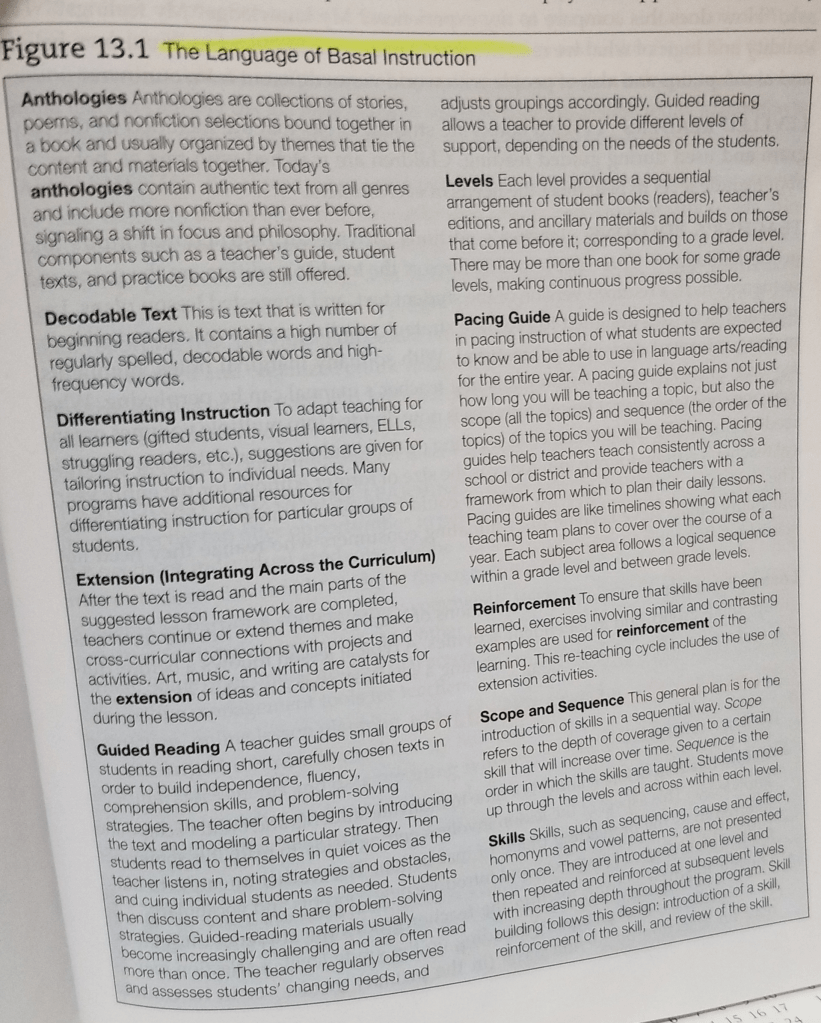
Lesson Framework consists of whole group, small group, and independent activities. The lesson can take place before, during, or after reading framework for teaching a selection over a number of days.
Modifying Basal Lessons – can be done by understanding how to use the various leveled books to assist students with reading at their ability level. The focus skill remains the same, but the activity or materials used are differentiated to meet the student’s needs. Extra support materials assist struggling readers’ instruction while advanced readers utilize materials and activities that are more challenging.
MBL Continued- Within the core or basal teacher’s manual, strategies such as questions the author are presented. You can provide a more in-depth study of a particular strategy such as using the strategy with a professional journal article. Teachers can go through their core program teachers edition and materials, and determine what components they want to stress for that week. Then they can plan how they will explicitly teach those components to extend practice through center activities.
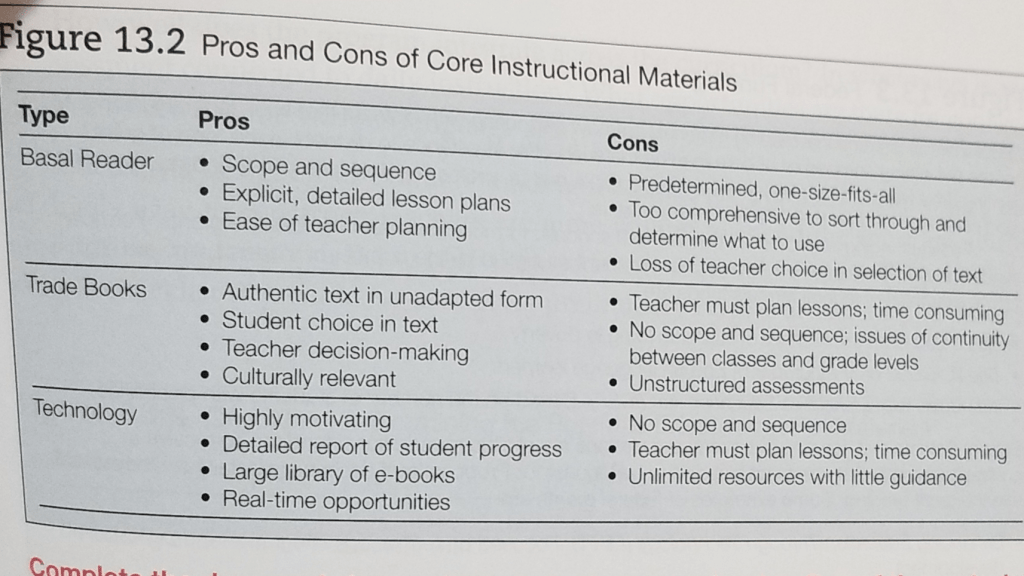

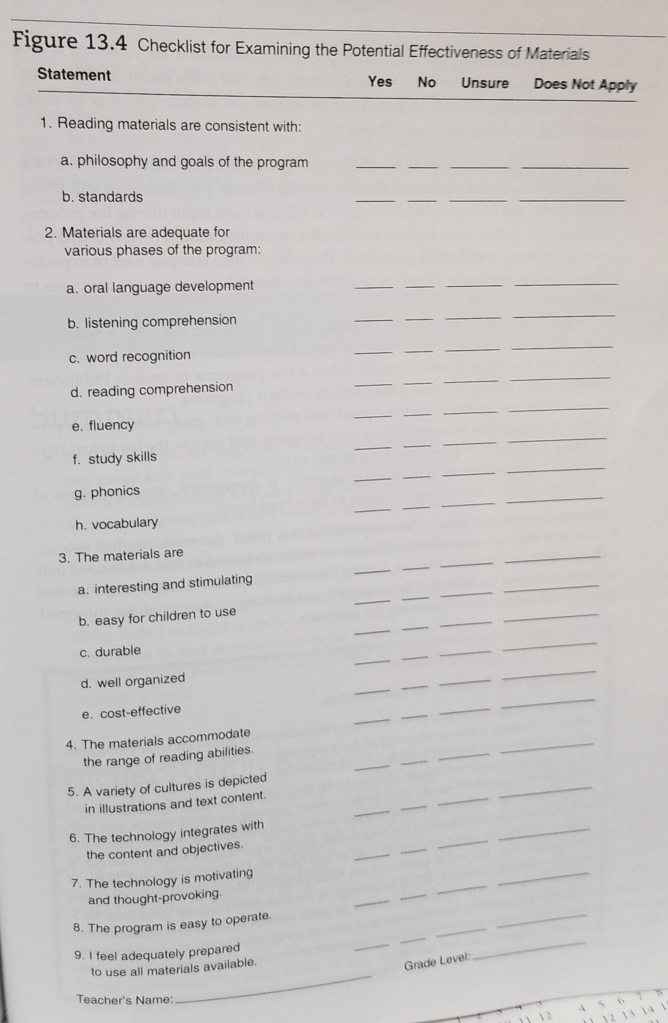
Evaluating Reading Materials – Social trends such as treatment of women and minorities, return to basics, and increasing involvement of parents have varying degrees of impact on curriculum development and materials selection. Depending on the community, other issues need to be considered. Censorship deals with peoples values. Objectionable matter is not the intended mission of most educational materials selection committees. New federal and state testing is another issue when selecting reading materials.
Baseline data for selecting a new basal program –
I really like basal reading programs especially as a new teacher. I feel like they are easy enough to follow step-by-step, but you can also manipulate them to provide better varying instruction to your students. Not all students are on the same reading level at all times, so being able to group students together, and vary the text level, and assignments that go along with the text is extremely beneficial to each group of students. This way each group is learning what they need to learn based on the core program, but still getting the individual time they need to move to the next level.
Encouraging students to read and write and integrating various texts create a community of readers. The idea of a community of readers to characterize how students, in alliance with their friends and teacher, work together in classrooms in which school reading becomes like adult reading, where adults are motivated to read. In these classrooms, students informally and spontaneously talk over their experiences with books and recommend books to each other.
Hooking Students on Books –
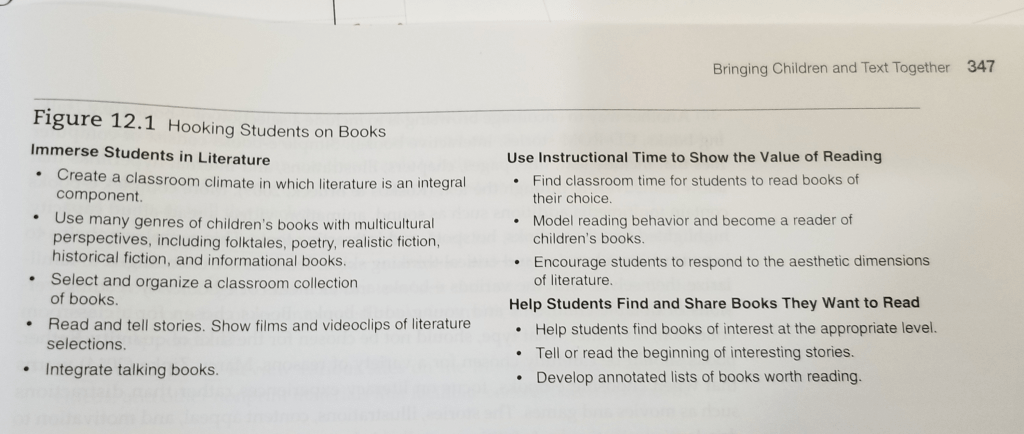
Selecting a Classroom Collection of Books – teachers need to include both literature and information text in their classroom collections. Literature books typically include a variety of genres such as stories, dramas, and poetry. Informational text includes nonfiction, historical, scientific, and technical readings.
Strategies used to choose classroom literature –
Determining good Literature –
Literature with Multicultural Perspectives – in a multicultural society made up of diverse groups who maintain their own cultural traditions and experiences, books help us celebrate our distinctive differences and understand our common humanity. Culturally diverse books in the US typically tell the stories of African Americans, Native Americans, Asian Americans, and Hispanic Americans through poems, folklore, picture books, realistic and historical fiction, biography and nonfiction. They can also represent literature of regional white and religious groups.
Designing the Classroom Library – As a classroom collection is compiled, the science, math, art, social studies, and music curricula need to be considered. Make sure there are materials on specific topics available in a wide range of reading levels because of the different reading abilities of students in the same grade. The classroom library should be highly visible. Clear boundaries should set the library area away from the rest of the classroom. The library should be a quiet place for five to six children to read away from the rest of the classroom.
Listening to Text is a great way to get students interested in the world of books. When students listen to literature and informational text, students – especially those from culturally and linguistically diverse backgrounds – are exposed to stories, information, and poems they cannot, or will not, often read on their own.
Choosing Texts to Read-Aloud – takes some thought and planning. Teachers should consider the age, background, and interests of their students when selecting books to read aloud. Sometimes teachers choose to link read aloud books together by genres and other attributes that make them related in some way.
Helping Students select books– Teachers can find ways to get students excited about books by telling exciting anecdotes about authors, providing previews of interesting stories, showing videos about stories, suggesting titles of stories that match students’ interests, encouraging author searches on the Internet, sharing leveled book listings, or compiling teacher-or-student-annotated books lists.
Core books are taught within the framework of whole class study across disciplines. Students have little or no choice in the selection of core books. As part of a whole class study, teachers assign various activities and use a variety of instructional strategies to support students’ interactions with the text. Often teachers use core books as springboards for independent reading in which students choose books with related themes and situations or decide to read other works by an author they have studied.
Literature Circles have small groups of children of varying reading abilities read together. These groups provide students with time and opportunity to use language to express their ideas, practice their speaking and listening skills, and explain their thinking to each other, which in turn extends the students’ thinking. Teachers who implement literature circles rely on cooperative learning strategies that show students how to work together and discuss books on the basis of their personal responses to what they have read.
Roles in literature circles – The roles utilized in literature circles vary depending on the purpose of the circle, the reading and the students. Generally there will be a leader who has the responsibility to lead the discussion, a student who monitors the text to assure that the discussion relates to specific sections of the text, and a student who tries to connect the discussion to real-life experiences and other literature.
Reader-response theory is a response theory that proclaims that the reader is crucial to the construction of the literary experience. A reader actively creates meaning by relating to his or her knowledge as well as past experiences to the book. The reader is thinking about, predicting, and verifying those predictions while actively creating meaning.
Some different ways to get responses to literature going are to create different ways for students to respond to the text such as: art, movement, music, creative drama, talk, and writing. They can use visual media, blogs, messengers, google hangouts, literature journals, and prompts such as “I agree with”, “I am confused with” and so on.
A Literature based reading program is a program that teachers plan out literature experiences for children that are meant to support children in developing literacy. It’s more than just reading a book, it’s discussing the book, and learning to ask questions.
A reading workshop is designed to allow for a whole group lesson to focus on one skill, strategy, or reading behavior and tailored to fit the needs of the class.
I really liked Rick’s reading workshop ideas. How he starts with a mini-lesson to get the ideas going, then he adds in more content throughout the time period. He has students converse with one another, and show emotions for comprehension. Then during silent reading he walks around and works with students individually. The video on organization made sense and I like kids being at tables vs their own desks so they can converse and work with one another. I felt like her word wall was a bit jumbled (I’m a bit more OCD and things would need to be lined up better). The way she had her books separated by levels and subjects was nice too. I think students would enjoy her classroom. The short video on how to choose a good book I really liked. I think every classroom should have those 4 book choice think abouts: 1. Why do I want to read? 2. What interests me? 3. Do I understand what I am reading? 4. Do I know the words I am reading? They are all great questions. Finally, how to pick the right book, was knowledge I already knew but a cute video to watch. The little boy was doing a great job reading, and I like how the Woman was explaining to him so he understands what books are right for him too.
I really liked the idea of giving students the chance to listen to literature. I think I would set up two spaces that could accommodate a few students to sit and listen to a book on tape and then read along with the tape together. I also want to have a few “quiet reading areas” where students can read in a small group without disturbing other readers. I could then walk around and check on all the students individually or in groups to see how they are doing reading. I sometimes think it’s better to have students work together than alone when they are reading because they can help each other.
Relationships Between Reading and Writing and Research – Supported by new knowledge about literacy development, today’s teachers recognize that when young children are engaged in writing, they are using and manipulating written language. In doing so, children develop valuable concepts about print and how messages are created. There is compelling historical evidence to suggest that writing and reading abilities develop concurrently and should be nurtured together. Contemporary research confirms the intricate relationships between reading and writing, but also suggests that reading and writing in the twenty-first century demand new literacy connections and skills that are necessary for communication. Also, teachers need to understand that the reading and writing connections for students from diverse backgrounds ought to be based on the roles reading and writing play in the social lives of people of various cultures.
Conclusions that can be drawn about the relationship between reading and writing:
Creating Environments for Reading and Writing: Classroom environments that are motivating include physical spaces that allow personal writing, collaborative writing, and sharing. When children believe in themselves as writers, are presented with expectations they can achieve, are provided with opportunities in which they have choices, and receive positive feedback regarding their efforts, they are likely to blossom as writers. Children are likely to develop competence when they are provided with direct instruction, clearly defined goals, and strategies for planning, drafting, and revising.
Encouraging Classroom Writing:
What can students write about? What are some occasions for writing?
The dialogue journal provides a natural setting in which the child and teacher converse in writing. A teacher’s response to children’s entries may include comments, questions, and invitations to children to further express their ideas.
A buddy journal is a variation of the dialogue journal. However, instead of a teacher engaging in written conversation with a student, a buddy journal encourages dialogue between children.
E-mail communication engages students in written conversations with others in the same learning conversations with others in the same learning community, at a neighboring school, or anywhere in the world. When students use e-mail, reading-writing connections are both personal and social )through key pal correspondence – the electronic equivalent of pen pals) and educational. When students communicate with key pals from other countries or communities, they have the opportunity to broaden their knowledge of diverse cultures, dispel misconceptions about cultures that differ from their own, and develop understanding of respect for differences.
A double-entry journal provides students with an opportunity to identify text passages that are interesting or meaningful to them and to explore-in writing-why. In the left-hand column, readers select quotes from the text- perhaps a word, a phrase, a sentence or two-that they find interesting. Then they copy it verbatim and identify the page from which the text is taken from. In the right-hand column, readers enter their personal responses and reactions to the text.
In contrast to double-entry journals, reading journals provide students with more structure and less choice in deciding what they will write about. The teacher often provides a prompt to guide students’ writing after a period of sustained reading.
The main difference between a reading journal and a response journal is the amount of prompting that teachers use to elicit students’ reactions to a text. Response journals invite readers to respond to literary texts freely, without being prompted.
In order to help students gather ideas that they might choose to craft as writing drafts, it is recommended to provide students with writing notebooks in which they gather observations, thoughts, reactions, ideas, unusual words, pictures, and interesting facts that might later spur them to write.
A multigenre project or paper is a collection of genres that reflects multiple responses to a book, theme, or topic. Students are given choices about which genres to use, and they experiment with writing in a variety of ways.
A plot scaffold is an open-ended script in which students use their imaginations and creative writing in a playful manner. The open-ended scripts include characters, setting, problem, and resolution with spaces for the students to write additional descriptions and problem-solving dialogue.
The Traditional Writing Process:
According to authors, the writing process should also include: scaffolding from teachers by –
Brainstorming is everything that writers do before the physical act of putting ideas on paper or on the screen for a first draft. “Getting it out” is a useful mnemonic because it helps us remember that brainstorming means activating background knowledge and experiences, getting ideas out in the open, and making plans for approaching the task of writing.
The writing workshop begins by providing students with the structure they need to understand, develop, or use specific writing strategies or by giving them direction in planning their writing or in revising their drafts.
The minilesson as the name implies, is a brief, direct instructional exchange (usually no longer than 10 minutes) between the teacher and the writing group.
A Writing Workshop Plan
A main purpose of a group share session is to have writers reflect on the day’s work. Process discussions focus on concerns implicit in the following questions:
Guided writing is an instructional framework in which teachers scaffold students’ writing as they write. Guided writing involves teaching skills that are needed by students based on actual observation, engaging the students in conversations as they write, and using prompts to guide instruction.
How to use technology to teach writing:
Classroom Application:
With today’s technology, I think having key pals in another state would be so much fun. Students could learn about different areas of the US that they might not otherwise have the chance to learn about. I remember growing up in Wisconsin and there were some children that had never traveled out of the state. Giving them the opportunity to talk with students in Florida, or California, to learn about their culture and what the demographics are like there would be so mind-opening for all parties.
Informational Text is explanatory in nature and conveys factual information meant to increase an individual’s knowledge of subject matter. Varieties include: textbooks, technical texts (such as how-to’s), manuals, newspaper and magazine articles, reports, summaries, and online resources, as well as books about science, history, social studies, and the arts.
Content learning also requires an understanding of academic language. Academic language refers to the words that are not typically used in everyday conversations, but rather vocabulary that relates to academic content. Tier 2 words are used across subject areas, such as alternate, sent, temporary, and frequent. Tier 3 words are content specific words that are critical to understanding the new concepts being learned from an informational text.
Examples of common Academic Task Vocabulary: Circle, Explain, List, Analyze, Prove, Summarize, Infer, Compare, Contrast, Define, Predict, Demonstrate, Identify, Critique, Persuade.
Questions to ask yourself about selecting Informational Text for Students:
When teachers judge instructional content area materials and informational text, they frequently assess readability. Readability formulas can help estimate the difficulty of any text, but they are not intended to be precise indicators. They typically involve a measure of sentence length and word length to ascertain a grade-level score for text materials. The score is meant to indicate the reading achievement level students would need to comprehend the material. More recently, text complexity has been measured by Lexile scales that use word frequency and sentence length to determine the difficulty of a text of the level on which a child can read.
Literature Circles typically involve grouping students and having them assume roles as they read a story. They can be effectively modified as a cooperative learning strategy in which informational text is shared in small groups; hence the name Informational text circles. When given a section or sections of text to read in small groups, each student assumes a role or purpose for reading and is responsible for reporting to the rest of the group regarding that role after a prescribed amount of time. Following the reading, each student typically shares the information they have learned based on the assigned task.
Jigsaw is another cooperative learning strategy in which students assume roles as they read and share their understanding of the content in small groups. Each group consists of 3-5 students of mixed ability, each student is given a copy of the same informational text or sections of a textbook to read. All groups will read and record information based off their section of the text to share with other groups. One expert from each group goes and shares the information with other groups.
Idea Sketches are graphic organizers that students complete in small groups as they read informational text. The purpose of the activity is for students to read a section of the text and focus on main ideas and supporting details, adding information to the organizers as they read.
The use of children’s literature and nonfiction trade books in elementary and middle school classrooms extends and enriches information provided in content area textbooks. Literature and nonfiction trade books have the potential to capture children’s imagination and interest in people, places, events, and ideas. And they also have the potential to develop in-depth understanding in ways that textbooks aren’t equipped to do.
It’s important for teachers to use a variety of genres when considering informational texts; it is recommended to use text sets that include storybook formats. Text sets are groups of books that share related concepts in different formats.
Generally there are three types of informational or nonfiction text types:
5 A’s of informational book selections: Authority, Author, Appropriateness, Artistry, Appearance.
Idea Circles are small peer-led group discussions of concepts fueled by multiple text sources. They are composed of 3-6 student. After introducing students to a concept, they each read different informational books, bringing unique information to the idea circle. In the circle, they discuss facts about this concept and relations among the facts and explanations.
Classroom Application:
I love text sets! I think they are such a wonderful way to get students interested in information that they might originally not have been due to lack of understanding or flat out it being boring. I am a big fan of expository informational texts because they not only give student and understanding of what a table of contents, glossary, along with lots of different text sizes and information. I think it would be fun to take a group of second graders and have them read an Expository informational text on animals. I would separate them into groups and have each group read a chapter from the text then share their ideas with the class using the Jigsaw technique. Then at the end each group could present one fact about each chapter they learned from their classmates.
Minilessons allow teachers to take the mystery out of comprehension and learning by sharing insights and knowledge students might otherwise never encounter.
Explicit strategy lesson create a framework that provides the instructional support students need to become aware of, use, and develop control over comprehension skills and strategies.
Literature that tells a story is considered narrative text and is characterized as fiction. There are many genres of narrative text: mysteries, fantasies, fairy tales, science fiction, myths, folk tales and historical fiction.
Stories typically have a setting or settings (where the story takes place), characters (people or animals or fantasy creations), a plot (typically a problem, difficulty, or puzzle that needs to be solved, and a solution to the problem.
When children hear stories, they develop a sense of story schema; where they begin to understand that stories have beginnings and endings, problems and solutions.
Story grammar helps specify the basic parts of a story and how they tie together to form a well-constructed piece of literature.
Elements in a Story: The setting of a story introduces the main character (sometimes called the protagonist) and situates the characters in a time and place. The plot of a story is made up of one or more episodes. These elements are usually included:
A story map is a way of identifying major structural elements, both explicit and implicit, underlying a story to be taught in class.
Building a Schema for stories: Activities that can be use to help students build a sense of story and reinforce their awareness of story structure –
Scaffolding comprehension strategies consider multiple levels of reading instruction, including decoding skills, vocabulary development, and context clues, as well as more specific comprehension strategy instruction. Good readers make connections as they read; they visualize, infer, and synthesize information; and they ask questions as they read.
Scaffolded instruction means that teachers model strategies side-by-side and explicitly demonstrate the processes of thinking before, during, and after one reads. Next, teachers provide the students with guided practice in the strategies, followed by independent practice and application.
Active Comprehension and Asking Questions – a common comprehension strategy is to have children answer questions about what is read.
When children are engaged in a process of generating questions and making connections throughout reading, they are involved in active comprehension. When selecting literature for active comprehension, it is important that teachers select stories that foster questions and understandings that reflect the diverse nature of their classrooms. Highlighting sections of copied text, recording questions on sticky notes, developing question maps, and coding questions are several additional strategies that can be effectively used with all students.
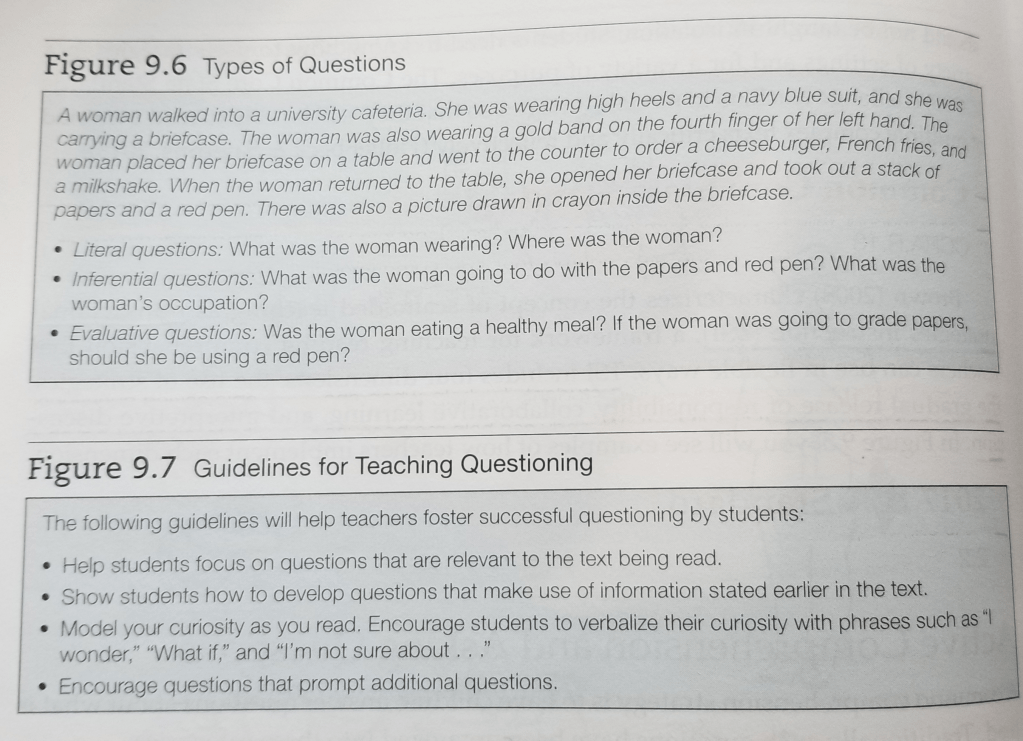
A means that the question is answered in the text
BK means it is answered from background knowledge
I means it was inferred
D refers to questions that can be answered by further discussion
RS requires further research for an answer
Huh? or C signals confusion
Reciprocal questioning also known as ReQuest is another strategy that encourages students to ask their own questions about the material being read. It can be used for one-on-one instruction or small group work –
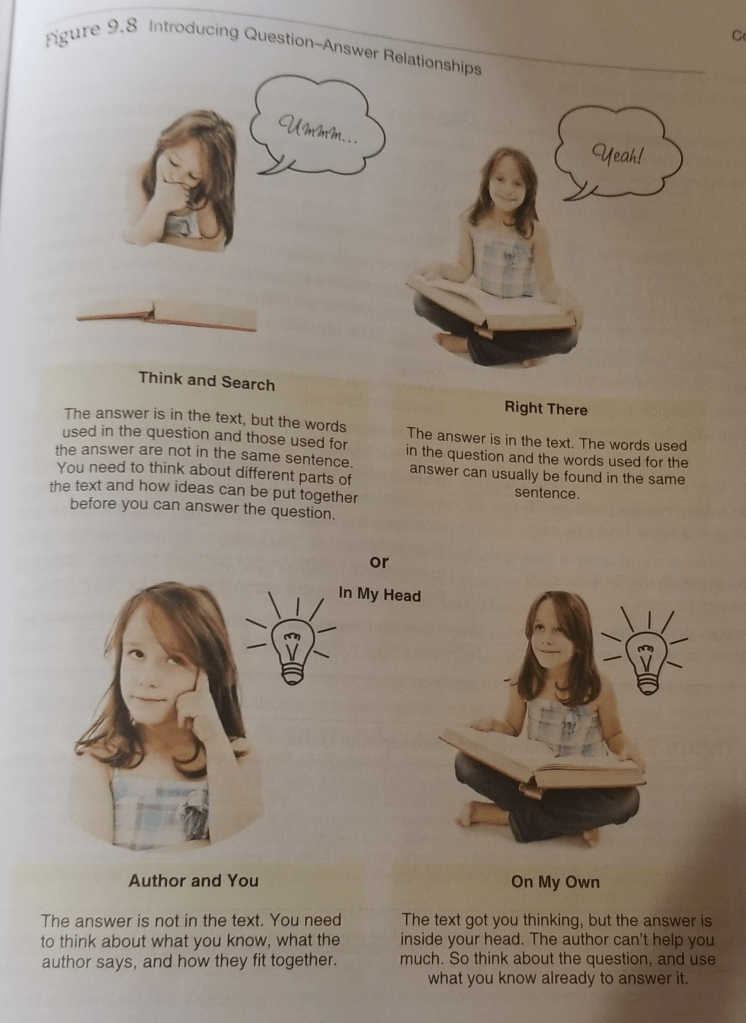
Question-answer relationships (QARs) help learners know what information sources are available for seeking answers to different types of text questions. As a result, teachers and students become cognizant of the three-way relationships that exist among the question, the text to which it refers, and the background knowledge and information at the reader’s disposal. QAR’s enhance children’s ability to answer comprehension questions by teaching them how to find information they need to answer questions.
Questioning the author (QtA) is another instructional strategy that models for students the importance of asking questions while reading. QtA strategy demonstrates the kinds of questions students need to ask in order to think more deeply and construct meaning about segments of text as they read. If what they are reading doesn’t make sense to them, successful readers raise questions about what the author says and means. QtA builds metacognitive knowledge by making students aware of an important principle related to reading comprehension: Not comprehending what the author is trying to say is not always the fault of the reader.
Close reading involves reading short selections of complex text multiple times and examining the text for evidence that answers text-specific questions. A purpose of close reading is to gain multiple levels of meaning for different purposes through analysis. A key focus of the CCSS is to foster close reading by developing a wide range of proficiencies including the ability to make logical inferences, to identify and summarize main ideas and details, to analyze text structure, and to interpret how words are used in texts.
Annotating text is notetaking strategy in which students jot down thoughts within the actual text and margins that indicate that the evidence that supports text based questions. In addition, highlighters, colored pens, or pencils can be used to mark the selection.
In close reading, activating prior knowledge is discouraged; the focus should be to gather information from the text itself, and personal responses are not considered important. We believe that schema and personal responses to literature do have roles in teaching reading comprehension, depending on the nature and purpose of reading the story, as well as the instructional needs of the students doing the reading. For example, if the reason for reading a story or short text selection is to analyze what the author is saying, personal connections are less important. However, when the purpose of reading a story is to relate to the characters, the problem, or solution to the problem on an aesthetic level, the goal of reading the story changes.
Reciprocal teaching is an approach to scaffolding reading comprehension in which teachers introduce four strategies, model the strategies, and gradually encourage independent use of the strategies in small groups as students take on the role of the teacher. The four strategies are (1) predicting what the text is about, (2) raising questions about the text, (3) summarizing the text, and (4) clarifying difficult vocabulary and concepts.
A think-aloud is a strategy in which teachers and students share their thoughts, discuss what they wonder about and what confuses them, and make connections as they are reading.
The directed reading-thinking activity (DR-TA) builds critical awareness of the reader’s role and responsibility in interacting with the text. The DR-TA strategy involves readers in the process of predicting, verifying, judging, and extending thinkin g about the material.
Discussion Webs require students to explore both sides of an issue during discussion before drawing conclusions.
Teaching and encouraging students to relate to what they are reading to their own experiences fosters comprehension as students relate what they are reading to themselves. An explicit way to teach children to do this is to model and provide opportunities for them to make text connections.
Reading Rockets Comprehension take-aways:
There are three hypothesis that are used to explain the relationship between vocabulary and comprehension: Aptitude hypothesis; Knowledge hypothesis and Instrumental hypothesis. All three have merit in explaining the relationship between word knowledge and comprehension. The implications of the aptitude and knowledge hypothesis signal the importance of reading aloud to children and immersing them in written language. The instrumental hypothesis is important to us as teachers because: if word meanings are taught well enough, students will find reading material easier to comprehend.
Vocabulary is the panoply of words we use, recognize, and respond to in meaningful acts of communication. Breadth involves the size and scope of our vocabulary, while depth concerns the level of understanding we have of words.
Vocabulary has been classified as having four components: listening, speaking, reading and writing. Because of the developmental nature of vocabulary, it is more or less assumed that listening and speaking vocabularies are learned in the home, whereas reading, writing, and transliteracy vocabularies fall within the domain of school.
Principles to Guide Vocabulary Instruction:
Best Practice: Strategies for Vocabulary and Concept Development – Direct vocabulary instruction shouldn’t be longer than 20 minutes a day.
Fluency means reading easily and well. The essential characteristic of fluency is the ability to decode and comprehend at the same time. The less important characteristics are accuracy and speed. There are 3 dimensions to fluency:
Effective fluency instruction has three parts:
When words cannot be read accurately from memory as sight words, they must be analyzed. In order to do this, students need to have word identification strategies such as phonics, structural analysis, and the use of context to figure out unknown words in order to move on and maintain comprehension.
Automaticity is when readers are both accurate and automatic, they can recognize or identify words accurately, rapidly, easily, and with little mental energy.
Prosody incorporates the characteristics of oral reading that allow it to sound expressive. Reading with expression, moods, feelings.
Predictable text have a context or setting that is familiar or predictable to most children. The pictures are supportive to the text, the language is natural, the story line is predictable, there is also repetitive language in the refrains.
There are several kinds of Predictable text:
Strategies for groups of students improve fluency. Students need explicit instruction focused on accuracy in word decoding, automatic reading, prosody, and how to self-monitor in order to improve their own fluency.
Choral Reading: is an enjoyable way to engage children in listening and responding to the prosodic feature in oral language in order to read with expression. Students will consider ways to get the author’s meaning across using prosodic cues such as pitch, loudness, stress, and pauses. Choral reading is reading aloud in unison with a whole class or group of students.
Echo Reading: is a method of modeling oral reading in which the teacher reads a line of a story and then the students echo by reading the same line back, imitating the teacher’s intonation and phrasing.
Fluency-orientated reading instruction (FORI) was developed for whole group instruction with a grade-level basal reader. FORI incorporates the research-based practices of repeated, assisted reading with independent silent reading within a three-part classroom program. The three components are a reading lesson that includes teacher-led, repeated oral reading and partner reading, a free-reading period at school, and home reading.
Reader’s theatre: is the oral presentation of a drama, prose, or poetry by two or more readers. The selection of literature if very important as reader’s theatre script generally contain a great deal of dialogue and are often adapted from literature.
Repeated Readings: are regular practice where a student reads a text several times until he or she achieves a certain level of automaticity that improves speed and comprehension. There are two type of repeated readings:
Paired Repeated Readings: students select their own passage from the material with which they are currently working. They are then grouped in pairs with another student who selected a different passage. This makes listening more interesting and encourages direct comparison of reading proficiency.
Fluency development lesson (FDL): was devised for primary teachers to help students increase reading fluency. The FDL takes about 10-15 minutes to complete and each child has a copy of the 50-150 word passage. The steps are:
Paired Reading: this is a particularly useful strategy in second and third grades where differences between the most fluent and the least fluent readers become evident. structured pair work between children of differing ability in which a more able child (tutor) helps a less able child (tutee) in a cooperative learning environment.
Automated reading listening while reading a text. An automated reading program employs simultaneous listening and reading (SLR). During SLR a child reads along with a recording of the story.
Oral recitation lesson (ORL) provides a useful structure for working on fluency in daily reading instruction. It has two components: direct instruction and student practice. The first component direct instruction incorporates comprehension, practice, and then performance. The second phase, indirect instruction involves practicing until mastery is achieved. Here are the steps:
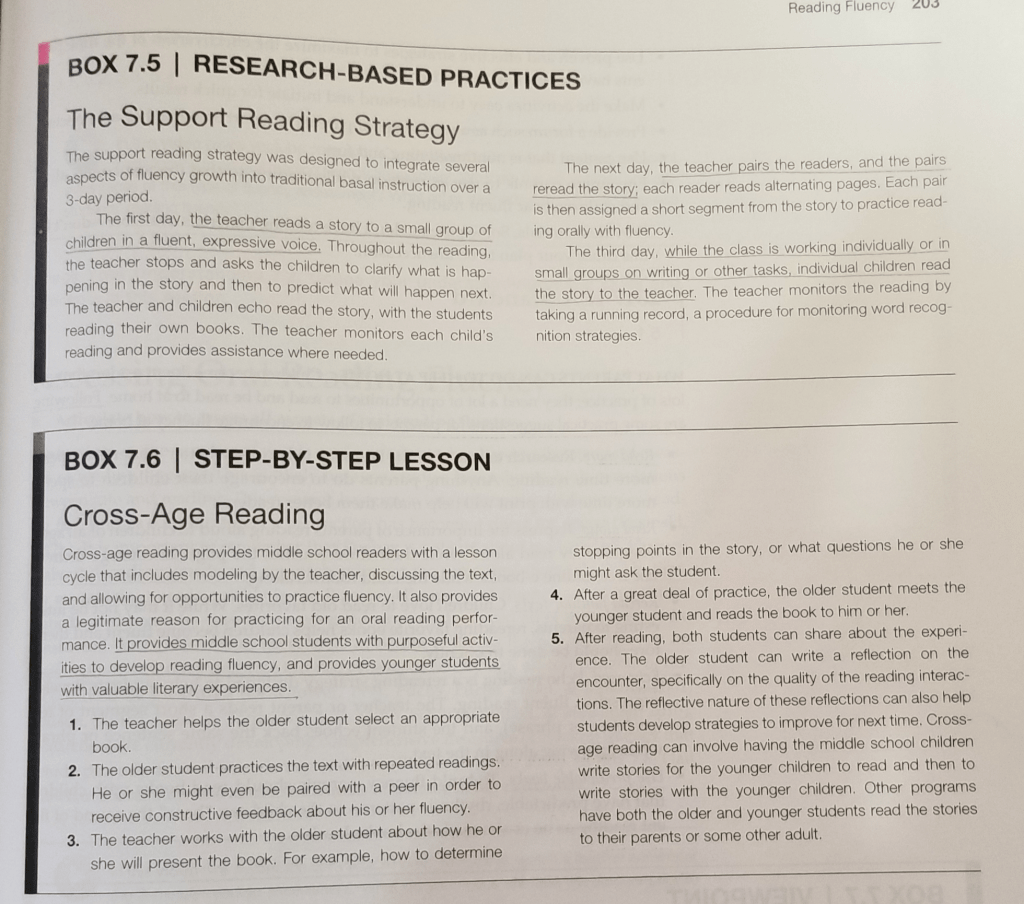
Involving parents is an essential part of literacy instruction. Many teachers develop home reading programs that motivate parents to read to their children on a regular basis. Some even hold evening workshops where they model simple strategies such as echo reading, choral reading, and repeated readings and then engage parents in discussions on the significance of the methods.
What parents can do to help at home:
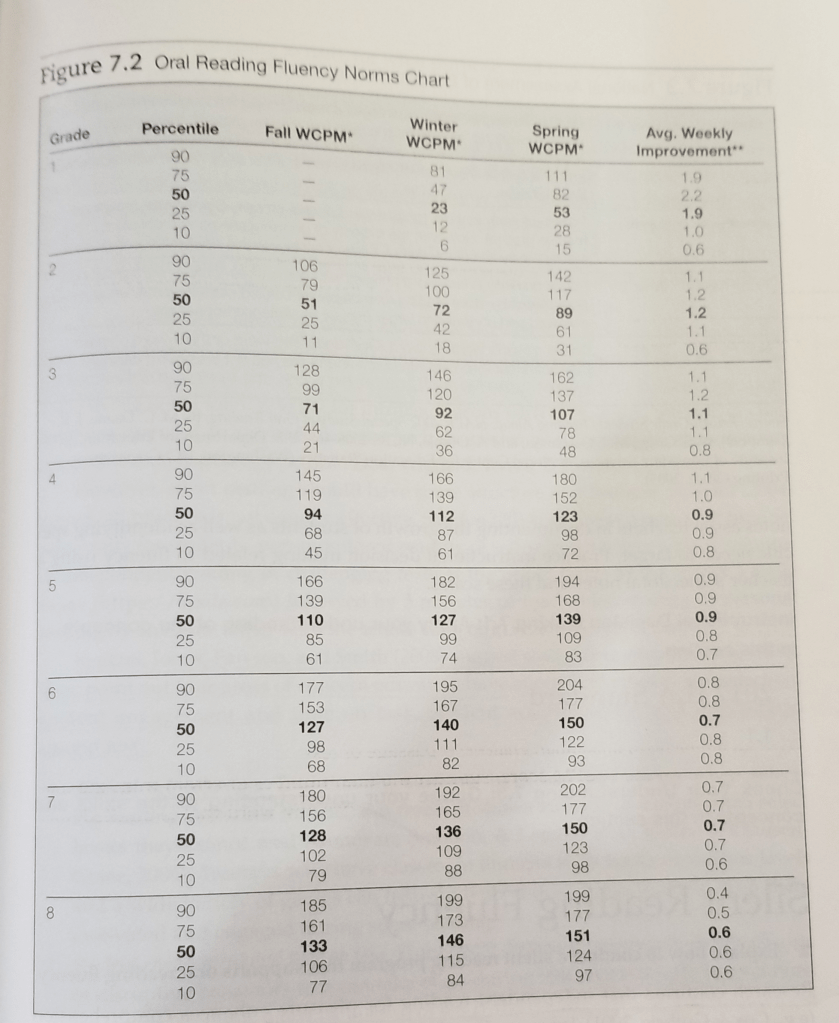
Assessing oral reading fluency – Reading rate or the number of words read per minute, has become the standard measure of reading fluency. Fluency is about decoding words and comprehending at the same time. Most tools available to assess fluency rely heavily on assessment of accuracy and rate but not prosody, even though all components of fluency should be measured.
To obtain Words-correct-per-minute (WCPM) score, students are assessed individually as they read aloud for 1 minute from an unpracticed, unfamiliar, grade-level passage of text. To calculate the WCPM score, subtract the total number of errors from the total number of words read in 1 minute. To determine whether the student’s score is on target, compare the WCPM score to an oral reading fluency norms chart to determine whether your student is reading above, below or on grade level.
Classroom Application: I could see using all of these methods in my classroom at one time or another, but I really like the idea of using peer tutoring. I think its great for one student who is above level to work with another student who is below level. Children learn so much from one another and they know how to describe things in ways that adults can’t. I really think one day a week in my classroom during reading time I would cut out a 15-20 minute block for paired student reading. I will already have my pairs made ahead of time and I will select a title appropriate for the reading. But I feel like if my student’s get used to doing that weekly they will know its coming and be prepared for it.
Word Identification means putting a name or label on words that are encountered in print.
Word recognition is a process that involves immediate identification of a word. It can be referred to as sight-word recognition or sight vocabulary. Learning to read words rapidly involves making associations between particular spellings, pronunciations, and meaning by applying knowledge of letter-sound relationship.
The terms word attack, word analysis, and decoding suggest the act of translating print into speech through analysis of letter-sound relationships.
Phonics provides readers with a tool to pronounce words by associating sounds (phonemes) with letters (graphemes). Phonics involves mediated word identification because readers must devote conscious attention to “unlocking” the alphabetic code.
Prealphabetic phase which has also been called the logographic or visual cue phase, and often occurs before the development of alphabetic knowledge. Children are able to recognize some words at sight during this phase because of distinctive visual and contextual cues in or around the recognized words.
Partial alphabetic phase is when children begin to develop some knowledge about letters and detect letter-sound relationships. This generally emerges during Kindergarten and first grade.
Full Alphabetic phase emerges in children’s literacy development when readers identify words by matching all of the letters and sounds. Some children can analyze words right away and other may need more carefully planned lessons that assist in the discovery of letter-sound relationships.
Consolidated alphabetic phase is when children become more skilled at identifying words. They rely less on individual letter-sound relationships and instead use their knowledge of familiar and predictable letter patterns to speed up the process of reading words. They develop the ability to analyze chunks of letters within words.
Readers at the consolidated alphabetic phase would be able to segment the words into sound units known as onsets (the initial consonants and consonant patterns that come at the beginning of syllables) and rimes (the vowel and consonants that follow them at the end of syllables).
Traditional Phonics Approaches include:
A syllable is a vowel or cluster of letters containing a vowel and pronounced as a unit.
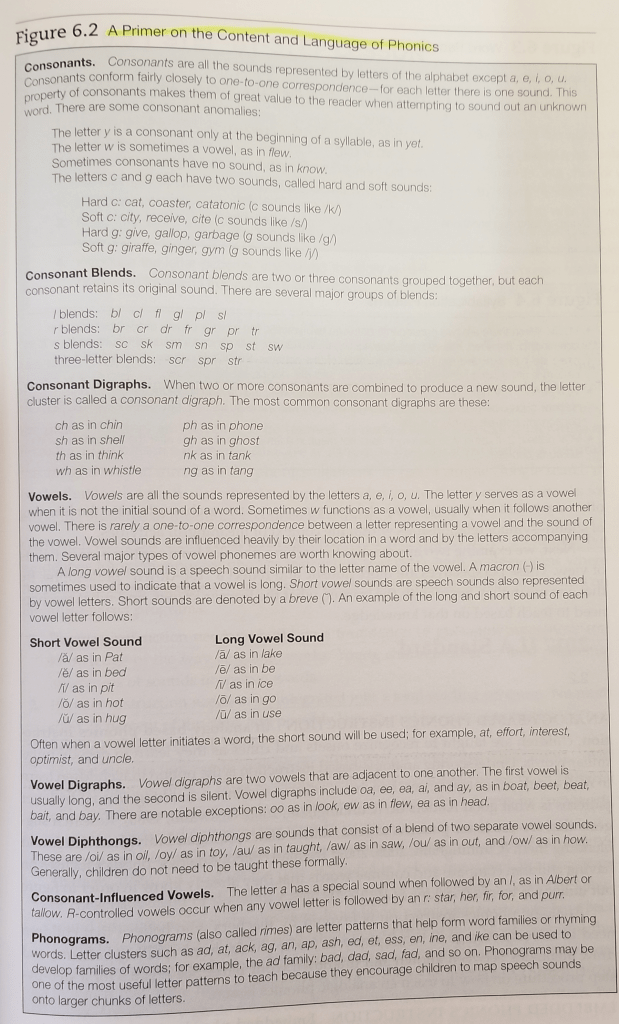
Contemporary approaches to phonics instruction do not emphasize an overreliance on worksheets, skill-and-drill activities, rules, or rote memorization. Think top-down.
Guidelines for Contemporary Phonics Instruction:
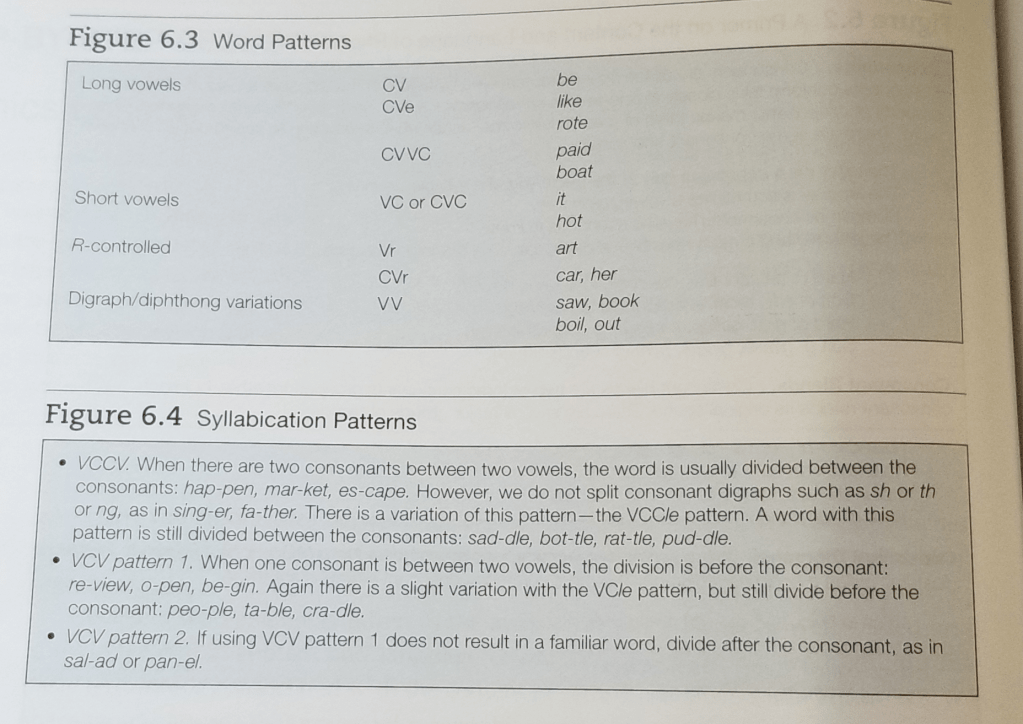
Strategies for Teaching Phonics:
5. Word Ladder: This is a game in which students add, delete, or replace letters in words to create new words that are prompted by clues.
6. Cube Words: Consonant substitution activities can also be developed using letter cubes. Students roll the cubes, using four to six cubes, depending on their ability level. Words are formed with the letters that are rolled.
Analogic-Based Strategies: is based on the premise that words with similar onset and rime patterns also have similar pronunciations.
Spelling-based strategies for word identification are designed to engage children in word study through the use of word banks, word walls, and word sorting strategies.
Cloze procedure is a strategy in which words or letters are omitted from the text and students are required to fill in the blanks using information from the passage. There are different deletion systems: selective word deletion, systematic word deletion, and partial word deletion.
Cloze with choices given: if students find it difficult to complete cloze activities, giving choices for the deleted words make the task easier.
Cross-checking simply involves rereading a sentence or two to “cross-check” – confirm, modify, or reject – probably pronunciations of unknown words encountered during reading.
When Self-monitoring students should not become dependent on the teacher or other readers when they encounter a hard word. Instead, the teacher should discuss with students what to do if they find a hard word. When children attempt to figure out unknown words in text, encourage them to use meaning and letter-sound information.
Structural analysis involves identifying words through meaningful units such as prefixes, suffixes, and root words. The smallest meaningful unit of a word is a morpheme. There are four principles for teaching morphology:
Structural analysis also includes inflected endings, which are suffixes that change the tense or degree of a word but not its meaning. (ing in going, d in saved, es in dresses)
High-Frequency words are words that appear over and over in print. HF word lists contain a large number of words that are grammatically necessary – words that are articles, conjunctions, pronouns, verbs of being, and prepositions that bind together information-bearing words. These words are called function words; they do much to help a sentence function, but they do not get across the meaning of a passage by themselves. Nouns, action verbs, adjectives, and adverbs are content words; they supply the content or information on the topic.
Linguistic Instruction is instruction based off of verbal standards. The teacher says words and students repeat them back.
Decodable texts are used in the beginning stages of reading and are carefully sequenced to progressively incorporate words that are consistent with the letters and corresponding phonemes that have been taught to the new reader.
Classroom Application:
Man this chapter had a ton of great information on ways to assist children in learning to read words. I’ve seen my son bring home flip books a lot this year. I didn’t have any clue what they were until I read this chapter! I really like the idea of Making words with students. I think after we read a book, it would be a great lesson to make words that were in the book so that students can make better sense of them. Especially in the K-1st Grade range. I thought it was interesting when I read that one of the first words children recognize is ball because of the tall peaks in the b and ll. I love writing poetry so I think it would be fun to have students who are in the 3rd grade range write a small poem using onsets and rimes.
Assessment in Reading involves understanding and appreciating how children interact with print in authentic reading situations and why.
High-Stakes Testing is a result of the Every Student Succeeds Act (2015) in which states are responsible for submitting accountability plans to the US DOE. These plans must address proficiency on tests, closing gaps in achievement, and other indicators such as graduations rates and English Language proficiency, Math and Science (depending on state). H-ST is intended to provide the public with a guarantee that students can perform at a level necessary to function in society and in the workplace. (Important: high stakes tests do NOT provide a complete picture of students literacy knowledge and accomplishments. This is why Assessments are so important)
Authentic Assessment: students are doing reading and writing tasks that look like real-life tasks and students are primarily in control of the reading or writing tasks. Students also develop ownership, engage thoughtfully and learn to asses themselves.
With Retelling a story a teacher can go beyond assessing the simple questions of the story and include understanding of the story and characterization. Teachers can use a clear rubric so that students can utilize the assessment tool themselves.
Performance-Based Assessments which require knowledge and problem-solving abilities representative of real-world purposes.
Formative Assessments are used to gather evidence to adapt to meet a students needs. They should show both strengths and weaknesses a student has. It also involves noticing details of literate behavior, interpreting student’s understanding and perspective, and knowing what the reader knows. It is purposeful, collaborative, dynamic, and descriptive, and contributes to improvement in teaching and learning.
Progress Monitoring takes place when teachers need to be able to diagnose reading and writing problems while monitoring the progress of each student.
Student self-assessments are a process-driven evaluation system where students have the ability to use assessments to change their behaviors, set goals, and redirect their learning efforts.
Formal Assessments are generally norm-referenced or criterion-referenced. Some incorporate both.
Standardized Diagnostic Test – is a type of formal assessment intended to provide information about individual students’ strengths and weaknesses. (Generally characterized by a battery of subtests that uses large numbers of items to measure specific skills in areas such as phonics, structural analysis, word knowledge, and comprehension)
Survey Test – represents a measure of general performance only. (Often used in the beginning of a year as a screening test to identify children having difficulties in broad areas of instruction.)
Criterion-referenced tests – these tests are judged by what a student can or cannot do with regard to the skill objectives of the test. The results aren’t compared to anyone else. The biggest difference between norm-referenced tests and criterion-based is that it will indicate strengths and weaknesses in certain skill areas. Whereas norm-based are used to screen students and to make a general grouping decision.
Informal Assessments – do not compare the performance of a tested group or individual to a normative population. Instead informal assessments are given throughout the year to individuals or groups for specific instructional purposes.
Informal Reading Inventory (IRI) is an administered reading test. It consists of a series of graded word lists, graded reading passages, and comprehension questions. The passages are used to assess how students interact with print orally and silently. IRI information can lead to instructional planning that will increase students’ effectiveness with print. When making and using an IRI, at least three steps are necessary –
Determining Reading Levels – Can be determined by administering and IRI
Miscues are an errors – or a deviation or difference between what a reader says an the word on the page. Miscues can be quantitative which involves counting the number of errors or qualitative which is a tool for assessing strengths of the students reading skills.
Miscue analysis is used to determine the extent to which the reader uses and coordinates graphic-sound, syntactic, and semantic information from the text. To analyze miscues you should as at least four questions –
Running Record is an assessment for determining students’ development of oral reading fluency and word identification skills and strategies.
Analyzing Running Records helps determine words read correctly, the amount of students errors, and identification of error patterns. To determine these we use formulas –
Anecdotal notes capture the gist of an incident that reveals something the teacher considers significant to understanding a child’s literacy learning. They are intended to safeguard against the limitations of memory. Charts are particularly useful for keeping anecdotal notes.
Checklists consist of categories that have been presented for a specific diagnostic purpose. They vary in scope and purpose and can be relatively short or long and more detailed. They should be used as a guide to consider and notice what students can do in terms of reading and writing strategies.
Interviewing is used so a teacher can discover what children are thinking and feeling. Periodic student interviews can lead to a better understanding of 1. reading interests and attitudes, 2. How students perceive their strengths and weaknesses, and 3. how they perceive processes related to langugage learning.
Words Correct Per Minute assessment involves children reading aloud for 1 minute from materials use in their lessons. As the students is reading the text, the teacher crosses out any word read incorrectly onto a copy of the text. To calculate teh score, the teacher counts to number of correctly read words, records, and then graphs the score in order to track changes in rates and accuracy over time.
Portfolios are collections of work that “document the literary development of a student” and include “evidence of student work in various stages.” They provide an opportunity to involve students in the assessment process because they can require students’ input and encourage them to think about their own literacy growth.
*Currently Tearing up from the Being Mr. Jensen Video*
Types of Assessment
Formal Vs Informal
Formal: developed by a group of educators at state/national level; data driven; norm-referenced strict testing procedures; measure longitudinal achievement
Informal: developed by teachers/small group of students; unsupported by data; criterion-referenced normal classroom testing procedures; measures shorter achievement
Formative vs Summative vs Diagnostic
Why Implement?
When to Implement:
Examples:
How to use:
Norm-Referenced Vs Criterion
Norm-Referenced: used to rank students based on test achievement; scores are given as a rank based on other students scores; assesses a very large group of students; tests usually take a long period of time; developed on a state/national level.
Criterion-Referenced: used to measure the kills and knowledge a student has mastered; student scores are given as a percentage; assesses a small number of students; tests usually last a class period; developed by a teacher.
Class Application:
I would use a Diagnostic approach for assessment when starting a new unit with my students about Story Structure. I would have all my students raise their hands and talk to me about the different aspects of story structure so I could get an understanding of what exactly they knew already. Then after that, I would give all my students the same book and we could talk about what the story might entail just from looking at the cover. While reading the book chapter for chapter we would learn more about story structure and what the different categories in story structure are and what they mean. At the end of the book as a summative assessment I would have my students create a story map to show what they have learned about the books story structure.
Emergent Literacy is a term used at the preK level and is a concept that supports learning to read as a result of a home environment where children begin learning about reading and writing from birth by observing and interacting with adults and other children as they use literacy in their everyday lives in meaningful ways.
Oral language development includes critical skills that allow children to communicate, to understand words and concepts they hear, to acquire new information, and to express their own thoughts and ideas.
How to promote Oral Language Development Every Day – parent and other caregivers should talk to their children throughout the day. Talk about what the child is doing and things of interest. Conversation should be frequent and meaningful.
How Reading Develops – most children may be the same age when they attend school but their stages of reading development vary widely. There are five stages to learning to read:
How Writing Develops – depends on those “paper-and-pencil kids” strong desire and need to show some self expression and communication. Young children learn writing through exploration. Young children write all over the paper in peculiar ways, turning letters around and upside down and letting the print drift over into drawing and coloring from time to time. We should be relaxed about this exploration of spaces and how print can be fitted into them.
Providing the opportunity for the child to talk about the picture, expand on the experience, and convey meaning is just as important as writing the dictated words near the picture.
Invented Spelling – name scribbling underscores this differentiation and results in the formation of valuable concepts about written language – namely that marking or symbols represent units of language such as letters and words, which in turn represent things and objects that can be communicated by messages. In this phase, there is no knowledge of the need to select and order letters to represent the order of sounds heard in spoken words. The intent is merely to make their writing look like words, and in fact they do believe they are words.
Oral language comprehension, the ability to listen and speak with understanding, is very important to later reading comprehension. As children’s vocabularies increase, they demonstrate specific cognitive skills such as classification and categorization. Generally children’s receptive (listening) vocabulary – hearing and understanding the language or languages of an environment – is larger that their expressive (spoken) vocabulary, which involves making and using the sounds of a child’s language or languages for communication.
Phonological Awareness involves hearing the sounds of language apart from its meaning. Young children learn phonological awareness through interactions with such things as nursery rhymes, books with repetitive patterns, songs, and clapping syllables.
Alphabet Knowledge is the ability to name, write, and identify the sounds of the 26 letters of the alphabet.
Print Knowledge is the ability to recognize print and understand that it works in specific ways and carries meaning and motivates the learn-to-read process. This includes concepts about print such as how to hold a book, how to turn a page, and to read left-to-right, top-to-bottom. It also includes that the text, not the illustrations, carry the message. Concepts about words is the consciousness that words carry meaning, and stories and text are built from words.
A Literate environment for young children is one that fosters interest and curiosity about written language and supports children’s efforts to become readers and writers. Children must learn how print functions in their lives and reading aloud to children is one of the most important contributing factors in the learning environment of early readers.
Children need to become aware of the many purposes of reading and frequently become involved in different kinds of reading activity. Years of research confirm children who read early have the following conditions in the home environment:
Design of the Classroom Area for a Literate Environment – in a classroom that promotes literacy development, children feel free to take risks because errors are expected an accepted. Effective teachers plan the environment so that children are engaged in interpreting and using print in meaningful ways. The environment in these classrooms is rich with print, representing language familiar to children and resulting from daily activities and thematic inquiry.
Literacy Play Centers provide an environment where children may play with print on their own terms. Play centers are usually based around the classroom topic of student and change with each study. Teachers can join the play in strategic ways to nudge children toward the literacy props.
Big books with their simple, repetitive refrains, colorful illustrations, and cumulative plot endings allow children to make predictions and participate immediately in shared reading experiences. In addition to the pleasure and enjoyment that children get when they participate in shared readings, and re-readings of big books, big-book formats are versatile in helping to achieve all the instructional goals for beginners.
Language experience activities in beginning reading instruction permit young children to share and discuss experiences; listen to and tell stories; dictate words, sentences, and stories; and write independently. They are an account that is told aloud by a child and printed by another person.
A good plan of instruction for teaching the alphabetic principle is to:
Phonological Awareness includes knowing that:
Phonological Awareness includes:
Phonemic awareness tasks:
Phonemic segmentation using elkonin (sound) boxes.
Classroom application:
There was so much information in this chapter! I really like the idea of using Elkonin boxes to segment sounds out better. I could see reading a book and setting my students up with a sheet that has two, three, and four elkonin boxes on them and then listing some of the harder words on the board so that after we could go over them using phonemic segmentation. We could sound them out together and students could write these sounds in the boxes accordingly to show what they have learned. (the video with the dry erase sheet was a wonderful idea. Saves paper, and is fun for students) I also like using big books. I think reading aloud first, then having the students read the sentences after I do is a great idea. The more repetition of words in different forms, the easier those words will become for my students.
The Videos –
Invented Spelling: She gives students the opportunity to write their own lists of what they would want at a party. (fun, and something students will love to write about!) Then she works with each of them individually while they correct, change and make letter/sound correlations. Super fun way to work on phonemic awareness!
Key Links Shared Reading – There was a ton of information in this one.
Shared Reading – First Grade: she reads, then has students read same sentence after her. She stops and asks students to talk about hard words. She then has students read book with her. She uses phonemic awareness to talk about different sounds in the book and has students use Elkonin boxes to write out sounds.

 virginiawilson