The primary instructional tool that teachers use to teach children to learn to read is referred to as the Core Reading Program. Core material will be used by the majority of elementary children, but teachers also use many supplemental materials as enrichment for some children and as reinforcement of basic skills for students who struggle.
Basal Readers are the most popular method used for reading instruction. A basal program is commercially designed and tends to offer more thorough and explicit instruction than many teachers can provide on their own. they also offer greater continuity from class to class and grade level to grade level, providing both vertical and horizontal articulation. They also save teachers time during searching and planning sessions, which gives the teacher more time to focus on students.
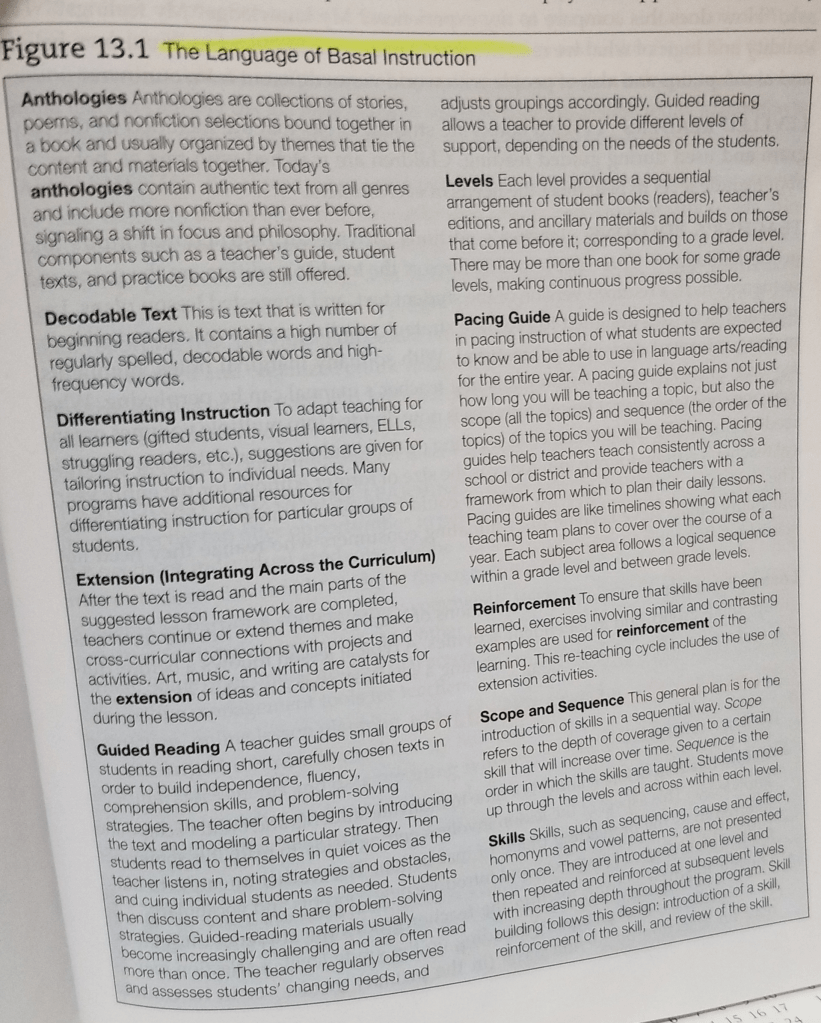
Lesson Framework consists of whole group, small group, and independent activities. The lesson can take place before, during, or after reading framework for teaching a selection over a number of days.
- Before Reading is a time to motivate students and build background knowledge. This aspect of the lesson involves getting ready to read. It is sometimes referred to as the prereading phase of instruction. The teacher attempts to build interest in reading, set purposes, and introduce new concepts and vocabulary.
- During Reading the teacher guides the students through the text, usually in small groups. Depending on the grade level, a selection may be read on a section-by-section basis (in the primary grades) or its entirety. Following silent reading, children may be asked to read the story aloud or orally read specific parts to answer questions. The guided reading phase of the lesson focuses on comprehension development through questions. Strategic reading, including explicit comprehension and vocabulary skill instruction, is explained in the teacher’s guide, along with prompts interspersed throughout the teacher’s copy of the story.
- After Reading is a time for the teacher to determine whether students understand main concepts and can incorporate what they just read into their core knowledge. It is a time to clarify, reinforce, and extend concepts. Teachers might ask students to confirm predictions or discuss comprehension questions, or provide skill development and practice activities centered on direct instruction of reading skills, arranged according to scope and sequence. Activities and exercises from the various practice books that accompany the basal might be used to reinforce skills in the broad area of word analysis and recognition, vocabulary, comprehension, and study skills.
Modifying Basal Lessons – can be done by understanding how to use the various leveled books to assist students with reading at their ability level. The focus skill remains the same, but the activity or materials used are differentiated to meet the student’s needs. Extra support materials assist struggling readers’ instruction while advanced readers utilize materials and activities that are more challenging.
MBL Continued- Within the core or basal teacher’s manual, strategies such as questions the author are presented. You can provide a more in-depth study of a particular strategy such as using the strategy with a professional journal article. Teachers can go through their core program teachers edition and materials, and determine what components they want to stress for that week. Then they can plan how they will explicitly teach those components to extend practice through center activities.
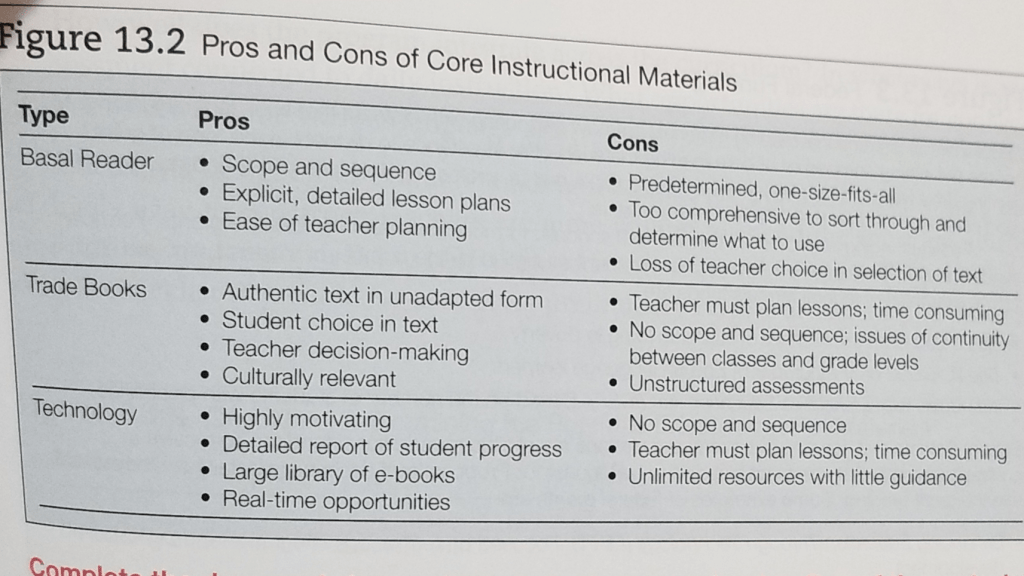

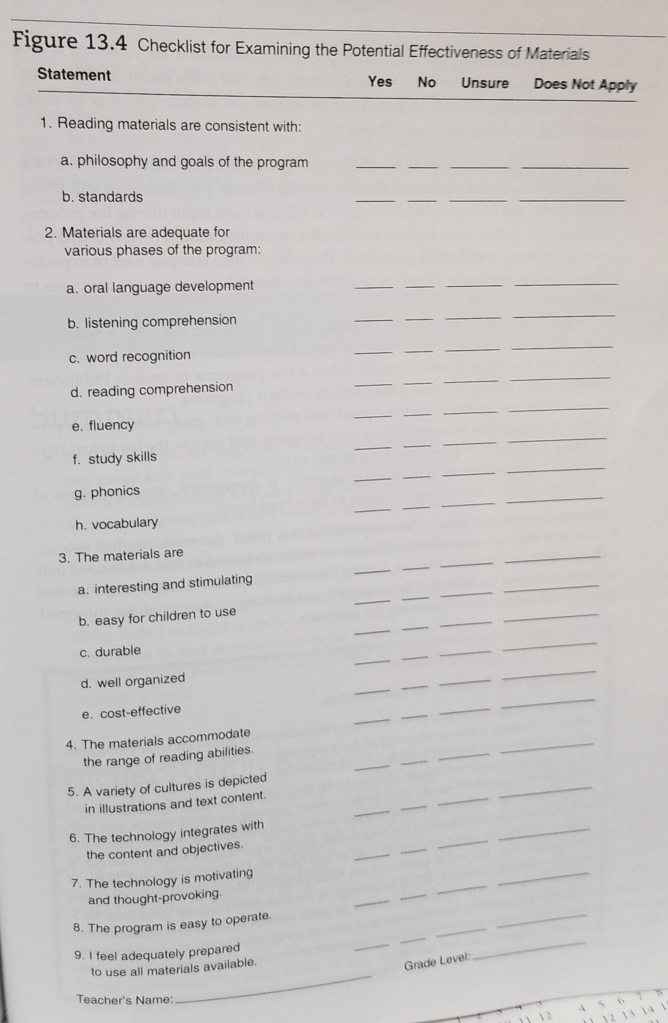
Evaluating Reading Materials – Social trends such as treatment of women and minorities, return to basics, and increasing involvement of parents have varying degrees of impact on curriculum development and materials selection. Depending on the community, other issues need to be considered. Censorship deals with peoples values. Objectionable matter is not the intended mission of most educational materials selection committees. New federal and state testing is another issue when selecting reading materials.
Baseline data for selecting a new basal program –
- What is the overall philosophy of the program? How is reading discussed in the teacher’s guides?
- What kind of learning environment does the program recommend? Is is child-centered? Teacher-centered? Literature-centered? Skills-based? Scientific?
- Describe the emergent literacy program in detail. How does it provide for communication between school and home?
- Describe the instructional program in detail. How are lessons structured to teach phonemic awareness, word identification, vocabulary, reading fluency, comprehension, and writing?
- Describe the literature of the program. Are the selections in unabridged form? Are different genres included? Is there a strong presence of nonfiction text? How culturally diverse is the literature?
- How well does the program integrate across the curriculum? In what ways is assessment connected to daily instruction? What opportunities are there for connections between the various language arts?
I really like basal reading programs especially as a new teacher. I feel like they are easy enough to follow step-by-step, but you can also manipulate them to provide better varying instruction to your students. Not all students are on the same reading level at all times, so being able to group students together, and vary the text level, and assignments that go along with the text is extremely beneficial to each group of students. This way each group is learning what they need to learn based on the core program, but still getting the individual time they need to move to the next level.
 virginiawilson