Encouraging students to read and write and integrating various texts create a community of readers. The idea of a community of readers to characterize how students, in alliance with their friends and teacher, work together in classrooms in which school reading becomes like adult reading, where adults are motivated to read. In these classrooms, students informally and spontaneously talk over their experiences with books and recommend books to each other.
Hooking Students on Books –
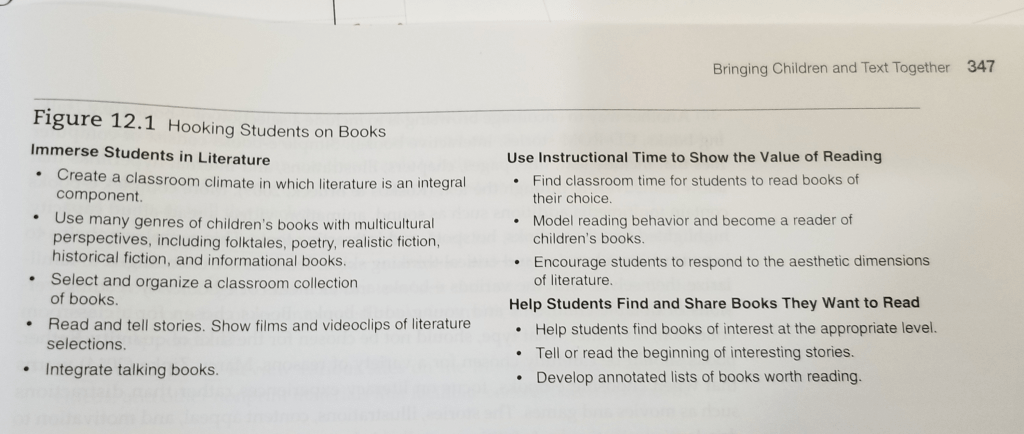
Selecting a Classroom Collection of Books – teachers need to include both literature and information text in their classroom collections. Literature books typically include a variety of genres such as stories, dramas, and poetry. Informational text includes nonfiction, historical, scientific, and technical readings.
Strategies used to choose classroom literature –
- Read and enjoy children’s and adolescent’s books yourselves so you are familiar with them.
- Read children’s and adolescent’s books with a sense of involvement.
- Read a variety of book types.
- Read books for a wide variety of ability levels.
- Share how your students respond to particular books with other teachers or other university students.
- Start by reading several books of good quality.
- Search the internet.
Determining good Literature –
- The collection needs to contain modern, realistic literature as well as more traditional literature.
- The collection needs to contain books that realistically present different ethnic and minority groups and nontraditional families as well as mainstream Americans.
- The collection needs to contain books with different types of themes and books of varying difficulty.
- The collection needs to include nonfiction.
- The collection of books needs to include e-books.
Literature with Multicultural Perspectives – in a multicultural society made up of diverse groups who maintain their own cultural traditions and experiences, books help us celebrate our distinctive differences and understand our common humanity. Culturally diverse books in the US typically tell the stories of African Americans, Native Americans, Asian Americans, and Hispanic Americans through poems, folklore, picture books, realistic and historical fiction, biography and nonfiction. They can also represent literature of regional white and religious groups.
Designing the Classroom Library – As a classroom collection is compiled, the science, math, art, social studies, and music curricula need to be considered. Make sure there are materials on specific topics available in a wide range of reading levels because of the different reading abilities of students in the same grade. The classroom library should be highly visible. Clear boundaries should set the library area away from the rest of the classroom. The library should be a quiet place for five to six children to read away from the rest of the classroom.
- it should have comfortable seating, such as bean bags, carpet pieces, or special chairs
- it should hold five or six books per child
- Multiple copies should be included
- books in the library should be organized and labeled by genre, theme, topic, author, reading level, or content area.
- book orientated displays such as flannel boards, puppets, book jackets, posters, and talking books boost interest and enthusiasm.
Listening to Text is a great way to get students interested in the world of books. When students listen to literature and informational text, students – especially those from culturally and linguistically diverse backgrounds – are exposed to stories, information, and poems they cannot, or will not, often read on their own.
Choosing Texts to Read-Aloud – takes some thought and planning. Teachers should consider the age, background, and interests of their students when selecting books to read aloud. Sometimes teachers choose to link read aloud books together by genres and other attributes that make them related in some way.
Helping Students select books– Teachers can find ways to get students excited about books by telling exciting anecdotes about authors, providing previews of interesting stories, showing videos about stories, suggesting titles of stories that match students’ interests, encouraging author searches on the Internet, sharing leveled book listings, or compiling teacher-or-student-annotated books lists.
Core books are taught within the framework of whole class study across disciplines. Students have little or no choice in the selection of core books. As part of a whole class study, teachers assign various activities and use a variety of instructional strategies to support students’ interactions with the text. Often teachers use core books as springboards for independent reading in which students choose books with related themes and situations or decide to read other works by an author they have studied.
Literature Circles have small groups of children of varying reading abilities read together. These groups provide students with time and opportunity to use language to express their ideas, practice their speaking and listening skills, and explain their thinking to each other, which in turn extends the students’ thinking. Teachers who implement literature circles rely on cooperative learning strategies that show students how to work together and discuss books on the basis of their personal responses to what they have read.
Roles in literature circles – The roles utilized in literature circles vary depending on the purpose of the circle, the reading and the students. Generally there will be a leader who has the responsibility to lead the discussion, a student who monitors the text to assure that the discussion relates to specific sections of the text, and a student who tries to connect the discussion to real-life experiences and other literature.
Reader-response theory is a response theory that proclaims that the reader is crucial to the construction of the literary experience. A reader actively creates meaning by relating to his or her knowledge as well as past experiences to the book. The reader is thinking about, predicting, and verifying those predictions while actively creating meaning.
Some different ways to get responses to literature going are to create different ways for students to respond to the text such as: art, movement, music, creative drama, talk, and writing. They can use visual media, blogs, messengers, google hangouts, literature journals, and prompts such as “I agree with”, “I am confused with” and so on.
A Literature based reading program is a program that teachers plan out literature experiences for children that are meant to support children in developing literacy. It’s more than just reading a book, it’s discussing the book, and learning to ask questions.
A reading workshop is designed to allow for a whole group lesson to focus on one skill, strategy, or reading behavior and tailored to fit the needs of the class.
I really liked Rick’s reading workshop ideas. How he starts with a mini-lesson to get the ideas going, then he adds in more content throughout the time period. He has students converse with one another, and show emotions for comprehension. Then during silent reading he walks around and works with students individually. The video on organization made sense and I like kids being at tables vs their own desks so they can converse and work with one another. I felt like her word wall was a bit jumbled (I’m a bit more OCD and things would need to be lined up better). The way she had her books separated by levels and subjects was nice too. I think students would enjoy her classroom. The short video on how to choose a good book I really liked. I think every classroom should have those 4 book choice think abouts: 1. Why do I want to read? 2. What interests me? 3. Do I understand what I am reading? 4. Do I know the words I am reading? They are all great questions. Finally, how to pick the right book, was knowledge I already knew but a cute video to watch. The little boy was doing a great job reading, and I like how the Woman was explaining to him so he understands what books are right for him too.
I really liked the idea of giving students the chance to listen to literature. I think I would set up two spaces that could accommodate a few students to sit and listen to a book on tape and then read along with the tape together. I also want to have a few “quiet reading areas” where students can read in a small group without disturbing other readers. I could then walk around and check on all the students individually or in groups to see how they are doing reading. I sometimes think it’s better to have students work together than alone when they are reading because they can help each other.
 virginiawilson