Minilessons allow teachers to take the mystery out of comprehension and learning by sharing insights and knowledge students might otherwise never encounter.
Explicit strategy lesson create a framework that provides the instructional support students need to become aware of, use, and develop control over comprehension skills and strategies.
Literature that tells a story is considered narrative text and is characterized as fiction. There are many genres of narrative text: mysteries, fantasies, fairy tales, science fiction, myths, folk tales and historical fiction.
Stories typically have a setting or settings (where the story takes place), characters (people or animals or fantasy creations), a plot (typically a problem, difficulty, or puzzle that needs to be solved, and a solution to the problem.
When children hear stories, they develop a sense of story schema; where they begin to understand that stories have beginnings and endings, problems and solutions.
Story grammar helps specify the basic parts of a story and how they tie together to form a well-constructed piece of literature.
Elements in a Story: The setting of a story introduces the main character (sometimes called the protagonist) and situates the characters in a time and place. The plot of a story is made up of one or more episodes. These elements are usually included:
- A beginning or initiating event – either an idea or an action that sets further events into motion.
- Internal response (followed by a goal or problem) – the character’s inner reaction to the initiating event, in which the character sets a goal or attempts to solve a problem
- Attempts – the character’s efforts to achieve the goal or alleviate the problem; several attempts may be evident in an episode.
- One or more outcomes – the success or failure of the character’s attempts
- Resolution – the long-range consequence that evolves from the character’s success or failure to achieve the goal or resolve the problem.
- A reaction – an idea, emotion, or further event that expresses a character’s feelings about success or failure in reaching a goal or resolving a problem or that relates the events in the story to some borader set of concerns.
A story map is a way of identifying major structural elements, both explicit and implicit, underlying a story to be taught in class.
Building a Schema for stories: Activities that can be use to help students build a sense of story and reinforce their awareness of story structure –
- Read, tell, and perform stories in class
- Show relationships between story parts
- Reinforce story knowledge through Instructional Activities
- Story Frames – present a way of heightening an awareness of stories. Story frames may be particularly appropriate in the primary grades or in situations in which students are at risk in their development as readers. A story frame provides the student with a skeletal paragraph: a sequence of spaces tied together with transition words and connectors that signal a line of thought. There are five story frames: plot summary, setting, character analysis, character comparison, and the story’s problem.
- Circular Story Map uses pictures to depict the sequence of events leading to the problem in the story. this strategy is useful for students whose strengths include visual representation.
Scaffolding comprehension strategies consider multiple levels of reading instruction, including decoding skills, vocabulary development, and context clues, as well as more specific comprehension strategy instruction. Good readers make connections as they read; they visualize, infer, and synthesize information; and they ask questions as they read.
Scaffolded instruction means that teachers model strategies side-by-side and explicitly demonstrate the processes of thinking before, during, and after one reads. Next, teachers provide the students with guided practice in the strategies, followed by independent practice and application.
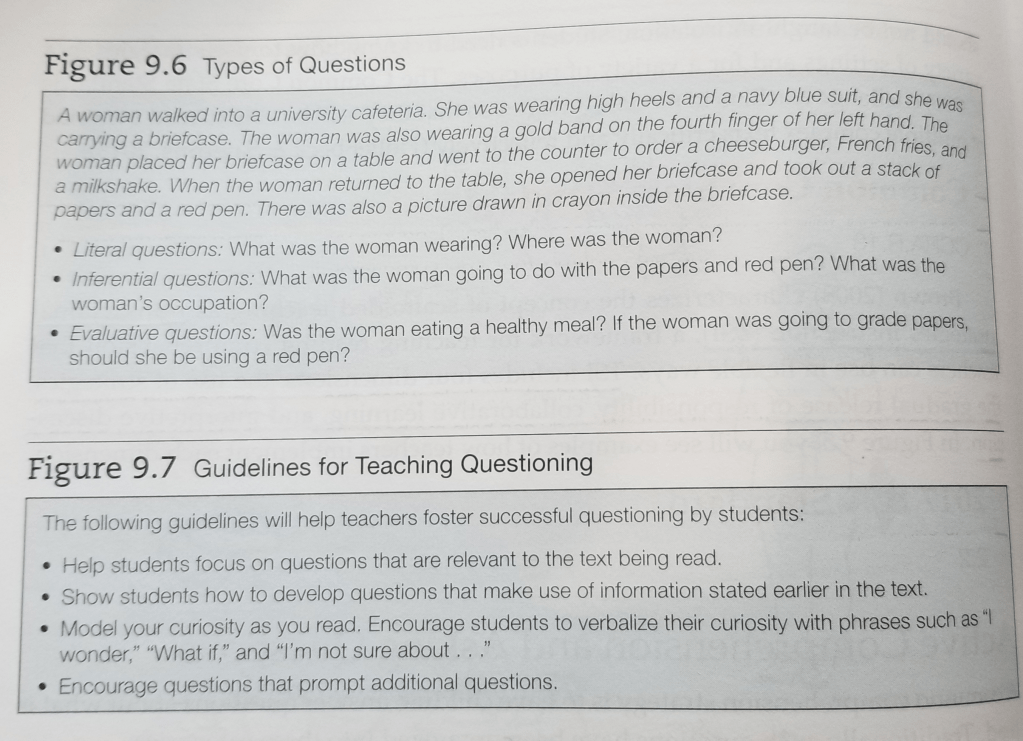
Active Comprehension and Asking Questions – a common comprehension strategy is to have children answer questions about what is read.
- Students answer literal questions by using information explicitly stated in the text.
- Students answer inferential questions by using their background knowledge along with information from the text.
- Students answer evaluative (or critical reading) questions by making judgments about what they read.
When children are engaged in a process of generating questions and making connections throughout reading, they are involved in active comprehension. When selecting literature for active comprehension, it is important that teachers select stories that foster questions and understandings that reflect the diverse nature of their classrooms. Highlighting sections of copied text, recording questions on sticky notes, developing question maps, and coding questions are several additional strategies that can be effectively used with all students.
A means that the question is answered in the text
BK means it is answered from background knowledge
I means it was inferred
D refers to questions that can be answered by further discussion
RS requires further research for an answer
Huh? or C signals confusion
Reciprocal questioning also known as ReQuest is another strategy that encourages students to ask their own questions about the material being read. It can be used for one-on-one instruction or small group work –
- The teacher selects a story for the group to read and divides the literature into logical stopping points
- The group, including the teacher, reads to first section silently with the intent of asking a question or questions after reading.
- The teacher models questions, and small group discussion takes place.
- The next section is read silently followed by another question or questions by the teacher and small group discussion.
- After the next section is read, the children begin asking their questions, followed by group talk.
- The procedure continues with the teacher and students taking turns asking questions.
- Prompts can be displayed in the classroom to assist students with higher level questions.
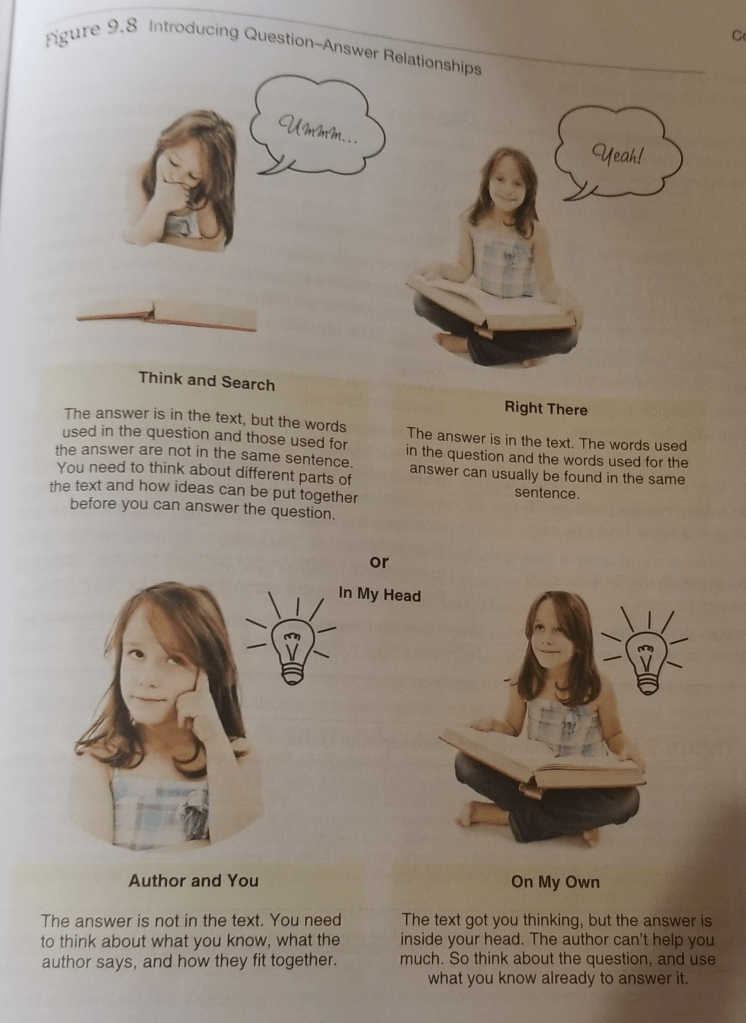
Question-answer relationships (QARs) help learners know what information sources are available for seeking answers to different types of text questions. As a result, teachers and students become cognizant of the three-way relationships that exist among the question, the text to which it refers, and the background knowledge and information at the reader’s disposal. QAR’s enhance children’s ability to answer comprehension questions by teaching them how to find information they need to answer questions.
Questioning the author (QtA) is another instructional strategy that models for students the importance of asking questions while reading. QtA strategy demonstrates the kinds of questions students need to ask in order to think more deeply and construct meaning about segments of text as they read. If what they are reading doesn’t make sense to them, successful readers raise questions about what the author says and means. QtA builds metacognitive knowledge by making students aware of an important principle related to reading comprehension: Not comprehending what the author is trying to say is not always the fault of the reader.
Close reading involves reading short selections of complex text multiple times and examining the text for evidence that answers text-specific questions. A purpose of close reading is to gain multiple levels of meaning for different purposes through analysis. A key focus of the CCSS is to foster close reading by developing a wide range of proficiencies including the ability to make logical inferences, to identify and summarize main ideas and details, to analyze text structure, and to interpret how words are used in texts.
Annotating text is notetaking strategy in which students jot down thoughts within the actual text and margins that indicate that the evidence that supports text based questions. In addition, highlighters, colored pens, or pencils can be used to mark the selection.
In close reading, activating prior knowledge is discouraged; the focus should be to gather information from the text itself, and personal responses are not considered important. We believe that schema and personal responses to literature do have roles in teaching reading comprehension, depending on the nature and purpose of reading the story, as well as the instructional needs of the students doing the reading. For example, if the reason for reading a story or short text selection is to analyze what the author is saying, personal connections are less important. However, when the purpose of reading a story is to relate to the characters, the problem, or solution to the problem on an aesthetic level, the goal of reading the story changes.
Reciprocal teaching is an approach to scaffolding reading comprehension in which teachers introduce four strategies, model the strategies, and gradually encourage independent use of the strategies in small groups as students take on the role of the teacher. The four strategies are (1) predicting what the text is about, (2) raising questions about the text, (3) summarizing the text, and (4) clarifying difficult vocabulary and concepts.
A think-aloud is a strategy in which teachers and students share their thoughts, discuss what they wonder about and what confuses them, and make connections as they are reading.
The directed reading-thinking activity (DR-TA) builds critical awareness of the reader’s role and responsibility in interacting with the text. The DR-TA strategy involves readers in the process of predicting, verifying, judging, and extending thinkin g about the material.
Discussion Webs require students to explore both sides of an issue during discussion before drawing conclusions.
Teaching and encouraging students to relate to what they are reading to their own experiences fosters comprehension as students relate what they are reading to themselves. An explicit way to teach children to do this is to model and provide opportunities for them to make text connections.
- Text-to-Self – this is a text connection that asks the students to share what a piece of text reminds them of personally. For narrative text, this is typically related to the plot of the story, the actions of a character, the setting, the problem, or the solution.
- Text-to-Text – This is a text connection that asks the students to recall another text that reminds them of the one they are reading.
- Text-to-World – This type of connection is more inferential in nature because it asks the students to make connections beyond the story.
Reading Rockets Comprehension take-aways:
- Comprehension is so much more than simply decoding a word. A student has to have some sort of meaning that goes in hand with that word to really understand the material they are reading.
- Word attack skills that allow students to decode words in text accurately and fluently
- Vocabulary knowledge and oral language skills that help students understand the meaning of words
- Background knowledge that includes knowledge acquired at school
- Thinking and reasoning skills such as drawing inferences
- Motivation to learn and apply information so that students can reach automaticity
- Background knowledge on a subject is extremely important when it comes to comprehension. So talking about he subject ahead of time and letting students comment on it is best so they can listen to their peers and learn for themselves.
- For K-3 Students, getting them to understand the different parts of a story, (characters, plot, setting, etc.) are really big in getting them to comprehend which way a story goes. They should also learn about stories that jump around a bit or have a beginning, middle, and end. Some stories even have a before the beginning. Getting students to understand these complex situations will assist them in understanding the concepts in the story.
 virginiawilson