There are three hypothesis that are used to explain the relationship between vocabulary and comprehension: Aptitude hypothesis; Knowledge hypothesis and Instrumental hypothesis. All three have merit in explaining the relationship between word knowledge and comprehension. The implications of the aptitude and knowledge hypothesis signal the importance of reading aloud to children and immersing them in written language. The instrumental hypothesis is important to us as teachers because: if word meanings are taught well enough, students will find reading material easier to comprehend.
Vocabulary is the panoply of words we use, recognize, and respond to in meaningful acts of communication. Breadth involves the size and scope of our vocabulary, while depth concerns the level of understanding we have of words.
Vocabulary has been classified as having four components: listening, speaking, reading and writing. Because of the developmental nature of vocabulary, it is more or less assumed that listening and speaking vocabularies are learned in the home, whereas reading, writing, and transliteracy vocabularies fall within the domain of school.
Principles to Guide Vocabulary Instruction:
- Select Words That Children Will Encounter While Reading Text and Context Materials: Use Keywords (these words convey major ideas and concepts related to the passage content and are essential for understanding to take place), Useful Words (relevant words that are sometimes repeated), Interesting Words (words that tickle the imagination and create enthusiasm, excitement, and interest in the study of words), and Vocabulary-Building Words (which allow children to seek clues to word meanings on their own).
- Teach Words in Relation to Other Words: vocabulary words are often tied to basic concepts. When words are taught in relation to other words, students are actively drawn into the learning process.
- Teach Students to Relate Words to Their Background Knowledge: differing subjects are like folders inside the brain. We should ask, “What is it that students already know about that they can use as an anchor point, as a way of accessing this new concept.”
- Teach Words in Prereading Activities to Activate Knowledge and Use Them in Postreading Discussion, Response, and Retelling: through pre-reading activities, vocabulary words can be focused on before students read to help activate background knowledge in activities involving predicting. Pre-reading and post-reading activities that connect vocabulary words to content are more desirable that isolate vocabulary exercises. Acquiring, and using vocabulary in a variety of activities before, during, and after reading, including conversation help children develop language, vocabulary, and comprehension skills.
- Teach Words Systematically and in Depth: Knowing and teaching a word in depth means going beyond having students parrot back a definition. For children to understand and process vocabulary in depth, they need to restate the definition in their own words, compare the definition to their own experiences with the concept, or make up a sentence that clearly demonstrates the word’s meaning. Teachers can also by adding in oral language development activities such as initiating conversations, asking open-ended questions, and providing substantive feedback to promote student responses and develop expressive vocabulary.
- Awaken Interest in and Enthusiasm for Words: promoting students’ interest and engagement helps to develop rich vocabularies, especially for less advantaged students. when student see that learning words can be fun, they become interested and curious about them. Incorporating pictures, charts, audiotapes, videotapes, songs, and video clips allows students to learn vocabulary words in more than one format.
Best Practice: Strategies for Vocabulary and Concept Development – Direct vocabulary instruction shouldn’t be longer than 20 minutes a day.
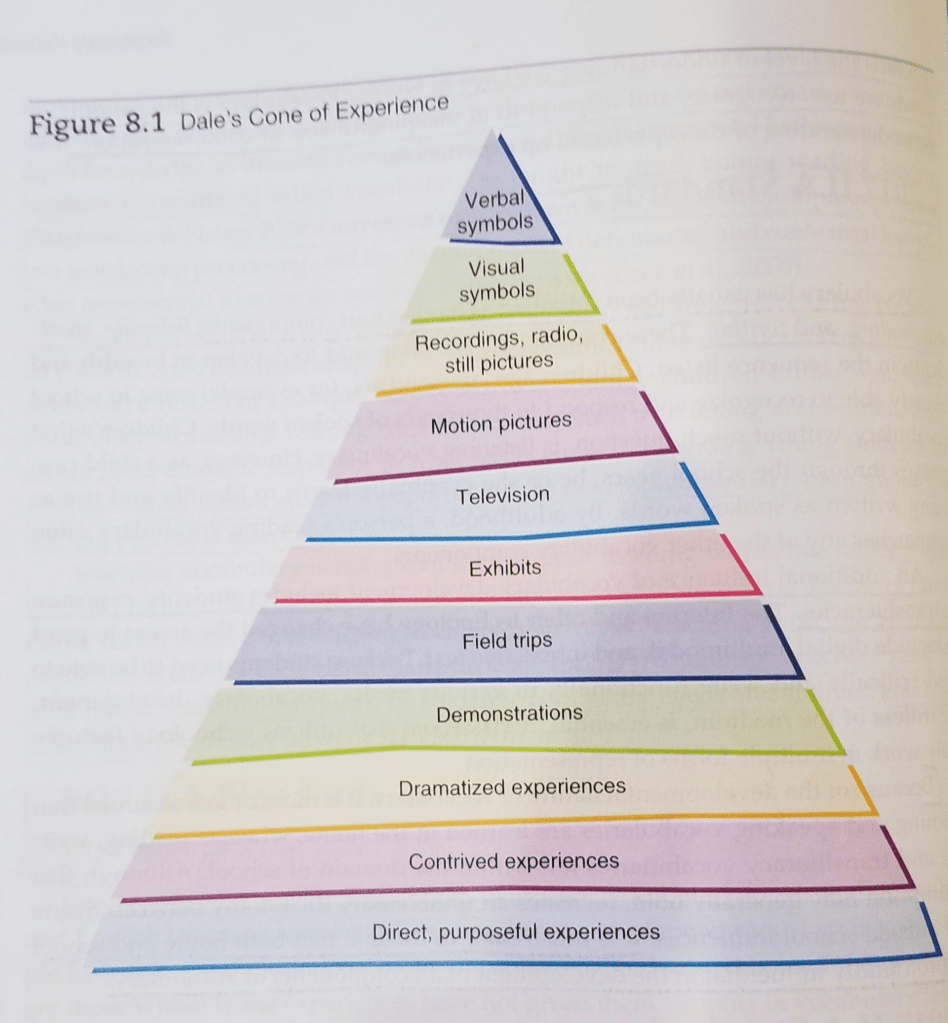
- Relate Experiences to Vocabulary Learning: Using Dale’s cone of Experience indicates possibilities for planning experiences that are vicarious: demonstrations, simulations, dramatization, visual and audio media, reading to children, keeping vocabulary logs and reading on one’s own. The use of technology also provides opportunities for students to see, hear, and use words.
- 2. Using Context for Vocabulary Growth: teachers and experts know that in addition to defining new terms, students need some examples of the concept; that is, students need to hear the new words used in different contexts. The instructional goal should be to teach students to use context to gain information about the meanings of new terms.
- Developing Word Meanings: Definitional knowledge, or the ability to relate new word to known words can be built through synonyms, antonyms, and multiple-meaning words. Synonyms are words that are similar in meaning to other words. Antonyms are words that are opposite in meaning to other words. Multiple-Meaning words give students opportunities to see how words operate in context. A strategy for dealing with multiple-meaning words involves prediction and verification.
- Classifying and Categorizing Words: involves vocabulary strategies and activities that get students thinking about, thinking through, and thinking with vocabulary. Through the aid of categorization and classification strategies, student recognize that they can group words that label ideas, events, or objects. This can be done through:
- Word Sorts: in which the objective is to group words into different categories by looking for shared features among their meanings. There are two type, open and closed sorts. In closed students know what the main categories are. The open sort has no category or grouping in advance and stimulates inductive thinking.
- Categorization: vocabulary activities involving categorization help students form relationships among words in much the same manner as word sorts, but instead the difference lies in the amount of assistance a child is given.
- Concept Circles: involves putting words or phrases in the sections of a circle and then directing students to describe or name the concept relationship among the sections.
- Semantic Mapping: or webbing, is a strategy that shows readers and writers how to organize important information. It’s a visual display of how words are related to other words. (aka, center word, build different webs of words off it)
- Analogies: is a comparison of two similar relationships. On one side of the analogy the words are related in some way, and on the other side the words are related in some way.
- Paired-word Sentence Generation: used after other strategies such as a word sort or categorization has been used. Gets students speaking and writing these words to show understanding of difficult concepts. The teacher will gives students two related words. The goal of the strategy is to generate one sentence that correctly demonstrates an understanding of the words and their relationship to each other.
- Think Sheet: a list of questions used to elicit responses about texts for discussion purposes.
- Predictogram: teachers choose words from a story that they feel will be challenging to the students. The words and their meanings are discussed in class, and students relate their personal associations with the words. Finally students work in groups to predict how they think the author might use each term in the story.
- Self-Selection strategy: is when children select the words to be studied. Students also get to explain why they think a word is important to learn.
- Word Knowledge Rating: is a way to get children to analyze how well they know vocabulary words. Words chosen by the teacher or by the students in the self-selection strategy are written on a worksheet or on the board. Then children can rate the word from something they have seen to something they know nothing about. 1. I’ve never seen the word, 2. I’ve heard of it but I don’t know what it means. 3. I recognize it in context. It has something to do with ______. 4. I know the word in one or several of its meanings.
 virginiawilson