Word Identification means putting a name or label on words that are encountered in print.
Word recognition is a process that involves immediate identification of a word. It can be referred to as sight-word recognition or sight vocabulary. Learning to read words rapidly involves making associations between particular spellings, pronunciations, and meaning by applying knowledge of letter-sound relationship.
The terms word attack, word analysis, and decoding suggest the act of translating print into speech through analysis of letter-sound relationships.
Phonics provides readers with a tool to pronounce words by associating sounds (phonemes) with letters (graphemes). Phonics involves mediated word identification because readers must devote conscious attention to “unlocking” the alphabetic code.
Prealphabetic phase which has also been called the logographic or visual cue phase, and often occurs before the development of alphabetic knowledge. Children are able to recognize some words at sight during this phase because of distinctive visual and contextual cues in or around the recognized words.
Partial alphabetic phase is when children begin to develop some knowledge about letters and detect letter-sound relationships. This generally emerges during Kindergarten and first grade.
Full Alphabetic phase emerges in children’s literacy development when readers identify words by matching all of the letters and sounds. Some children can analyze words right away and other may need more carefully planned lessons that assist in the discovery of letter-sound relationships.
Consolidated alphabetic phase is when children become more skilled at identifying words. They rely less on individual letter-sound relationships and instead use their knowledge of familiar and predictable letter patterns to speed up the process of reading words. They develop the ability to analyze chunks of letters within words.
Readers at the consolidated alphabetic phase would be able to segment the words into sound units known as onsets (the initial consonants and consonant patterns that come at the beginning of syllables) and rimes (the vowel and consonants that follow them at the end of syllables).
Traditional Phonics Approaches include:
- Analytic phonics is characterized as “whole-to-part” instruction. The children learn a whole word first and then analyze individual parts. Analytic lessons rely heavily on the use of wordbooks and practice exercises.
- Synthetic phonics is teaching sounds in isolation, followed by blending the sounds to form words.
- Intensive and systematic are tandem concepts often mentioned in the same breath by proponents of traditional phonics approaches. Intensive suggests a thorough an comprehensive treatment of letter-sound correspondences. Systematic implies that phonics instruction should be organized sequentially and in a logical order through structured lessons.
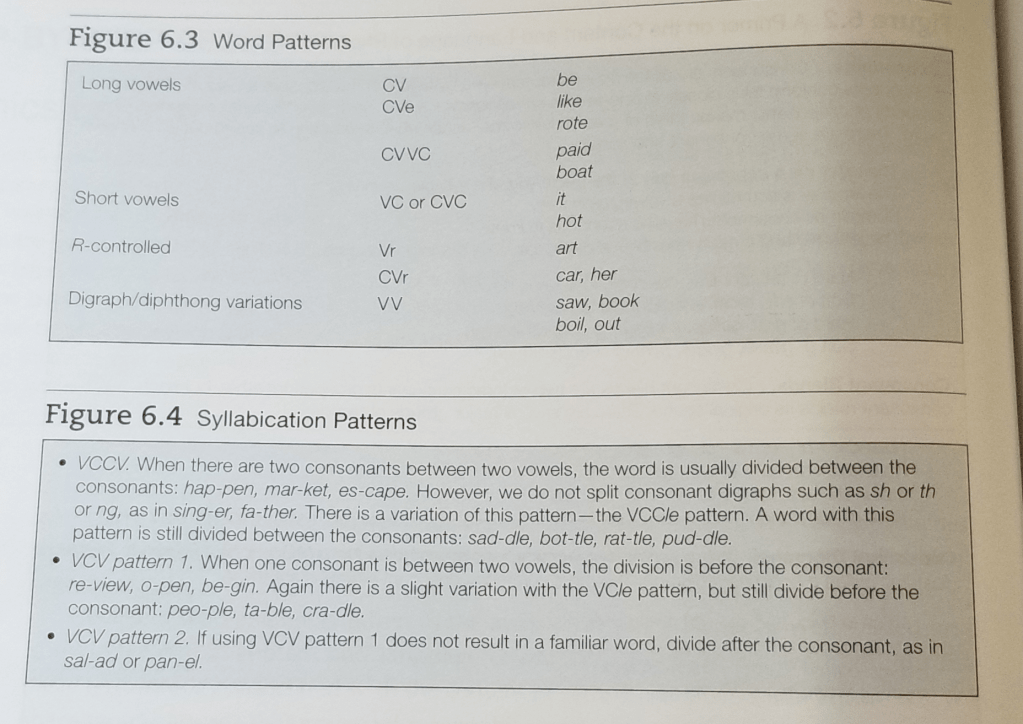
A syllable is a vowel or cluster of letters containing a vowel and pronounced as a unit.
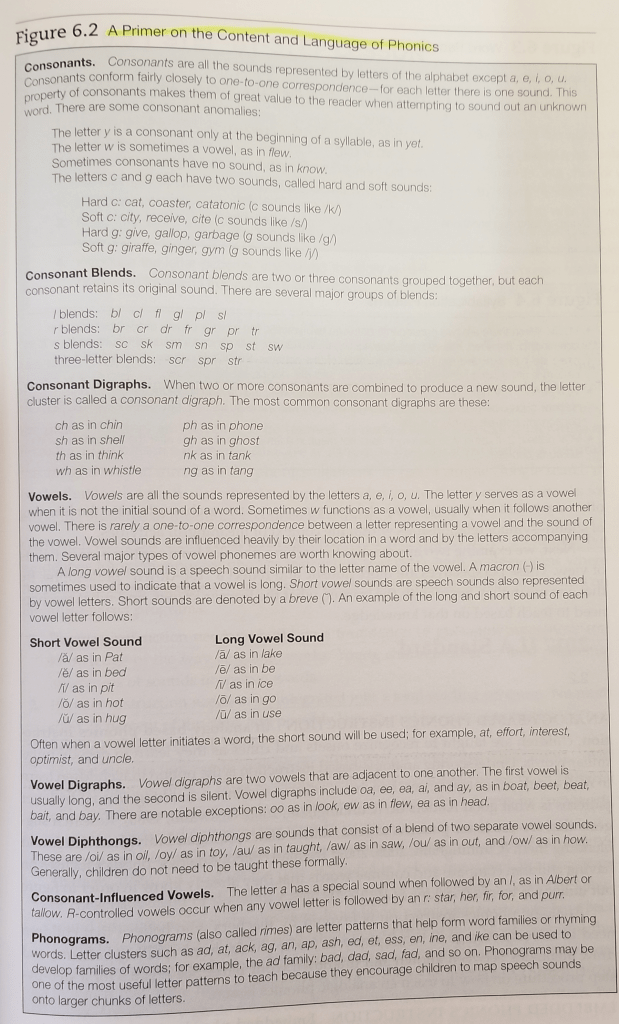
Contemporary approaches to phonics instruction do not emphasize an overreliance on worksheets, skill-and-drill activities, rules, or rote memorization. Think top-down.
- Analogy-based phonics instruction, children are taught to recognize onsets and rimes as they learn to decode unfamiliar words. Children learn to read words in context better than out of context and that “chunking words” by letter patterns is what good readers do. Analogic phonics focuses on having children compare and contrast words that they already know in order to figure out unknown words.
- Embedded phonics instruction is often associated with holistic, meaning-centered teaching. In literature-based instruction, students learn phonics skills in the context of stories that make sense. First a story is read, next word identification of letters, words, and phrases is studied within the context.
Guidelines for Contemporary Phonics Instruction:
- Phonics instruction needs to build on a foundation of phonemic awareness and knowledge of the way language works.
- Phonics instruction needs to be integrated into a total reading program. (No more than 25% of the time spent on the phonics portion)
- Phonics instruction needs to focus on reading print rather than on learning rules.
- Phonics instruction needs to include the teaching of onsets and rimes. An onset or part of a syllable before the vowel, is a consonant or consonant blend or digraph; a rime is the rest of the syllable. Phonograms or rimes have been found to be generalizable.
- Phonics instruction needs to include Invented spellings. When children are encourage to write and to use invented spellings, they use their knowledge of letter-sound relationships.
Strategies for Teaching Phonics:
- Multisensory Activities are instructional strategies that involve the senses, namely the visual, auditory, kinesthetic, and tactile modalities. Children who struggle with reading, including dyslexics, benefit from instruction that taps all of the senses; students see, hear, move, and touch or write as they are learning.
- Consonant Substitution: as students develop consonant letter-sound knowledge, you can use numerous activities to assist them with learning to read words that rhyme or belong to the same word family.
- Flip Books are made from sentence strips, which are ideal for creating small booklets for word study.
- Making Words: Flip books make students aware of their word-making capability when they substitute different consonant at the beginning of a rime.
- Decide on the rime that you wish students to practice, and develop a rime card for each of the students. (_all)
- Develop a set of consonant letter cards for each student that can be used to make words with the rime that has been targeted for practice. (b, c, f, h, m, t, w)
- Direct students to use the letter cards to make the first word. (ball)
- Invite students to now change the word to make (call).
- Repeat activity until all the words have been made.
5. Word Ladder: This is a game in which students add, delete, or replace letters in words to create new words that are prompted by clues.
6. Cube Words: Consonant substitution activities can also be developed using letter cubes. Students roll the cubes, using four to six cubes, depending on their ability level. Words are formed with the letters that are rolled.
Analogic-Based Strategies: is based on the premise that words with similar onset and rime patterns also have similar pronunciations.
- Poetry poems can be printed on large chart paper and posted in the classroom so that the rime patterns can be identified.
- Making and writing word using letter patterns: students are directed to write words using the patterns listed. This activity provides students with practice in using word patterns to decode longer words.
Spelling-based strategies for word identification are designed to engage children in word study through the use of word banks, word walls, and word sorting strategies.
- Word banks are boxes or collections of word cards that individual students are studying.
- Word Walls may be started when students notice words that rhyme but are not spelled with the same letter patterns. Intermediate and middle-level teachers often target homophones, compound words, or commonly misspelled words for student to reference.
- Word Sorting activities are another way to engage students in studying words. When sorting words, students look for similarities in words, including letter pattern similarities.
Cloze procedure is a strategy in which words or letters are omitted from the text and students are required to fill in the blanks using information from the passage. There are different deletion systems: selective word deletion, systematic word deletion, and partial word deletion.
- Using Selective word deletion, important nouns, verbs, adjectives, and adverbs can be left out.
- In systematic word deletion, every nth word in a passage is deleted. (ex, 4th, 5th)
- In partial word deletion every nth word or selected word is partially deleted. Three types of partial deletions can be used: 1. initial consonants, initial consonant blends, digraphs, or initial vowels are given, and all other letters are deleted. 2. The letters mentioned in option 1 plus ending consonants or ending consonant digraphs are given, all other letters are deleted. 3. consonants are given, and vowels are deleted.
Cloze with choices given: if students find it difficult to complete cloze activities, giving choices for the deleted words make the task easier.
Cross-checking simply involves rereading a sentence or two to “cross-check” – confirm, modify, or reject – probably pronunciations of unknown words encountered during reading.
When Self-monitoring students should not become dependent on the teacher or other readers when they encounter a hard word. Instead, the teacher should discuss with students what to do if they find a hard word. When children attempt to figure out unknown words in text, encourage them to use meaning and letter-sound information.
Structural analysis involves identifying words through meaningful units such as prefixes, suffixes, and root words. The smallest meaningful unit of a word is a morpheme. There are four principles for teaching morphology:
- teach within the context of rich vocabulary instruction that includes multiple ways of knowing words.
- Have students select words they don’t understand; study the words based on the meanings of prefixes, suffixes, and root words; make educated guesses about the meaning of the words; and check guesses about the meanings of words based on the contexts in which they are written.
- explicitly teach common prefixes, suffixes, and root words. These can be displayed as wall charts or word walls.
- for students who speak Spanish as their primary language, help them see the similarities between words in both languages.
Structural analysis also includes inflected endings, which are suffixes that change the tense or degree of a word but not its meaning. (ing in going, d in saved, es in dresses)
High-Frequency words are words that appear over and over in print. HF word lists contain a large number of words that are grammatically necessary – words that are articles, conjunctions, pronouns, verbs of being, and prepositions that bind together information-bearing words. These words are called function words; they do much to help a sentence function, but they do not get across the meaning of a passage by themselves. Nouns, action verbs, adjectives, and adverbs are content words; they supply the content or information on the topic.
Linguistic Instruction is instruction based off of verbal standards. The teacher says words and students repeat them back.
Decodable texts are used in the beginning stages of reading and are carefully sequenced to progressively incorporate words that are consistent with the letters and corresponding phonemes that have been taught to the new reader.
Classroom Application:
Man this chapter had a ton of great information on ways to assist children in learning to read words. I’ve seen my son bring home flip books a lot this year. I didn’t have any clue what they were until I read this chapter! I really like the idea of Making words with students. I think after we read a book, it would be a great lesson to make words that were in the book so that students can make better sense of them. Especially in the K-1st Grade range. I thought it was interesting when I read that one of the first words children recognize is ball because of the tall peaks in the b and ll. I love writing poetry so I think it would be fun to have students who are in the 3rd grade range write a small poem using onsets and rimes.
 virginiawilson