Multiple factors contribute to the diverse nature of today’s classrooms:
- Linguistic Diversity: the language in which the student feels most comfortable communicating is not the language of instruction in the school.
- Cultural Diversity: The student’s home, family, socioeconomic group, or culture differs from the predominant (often middle-class) culture of the school.
- Cognitive and academic Diversity: The child learns at a pace or in a style different from that expected at the school.
- Socioeconomic Diversity: students who come from areas of poverty that may not have access to books may be at risk of failing.
In addition to ELL’s learning a second language, they need to learn complex content with academic texts, as well as critical literacy skills. They need to be able to synthesize, infer, analyze, criticize, and compare and contrast complex text.
Students benefit from opportunities to connect what they know about literacy in their primary language to their new language.
Translanguaging: a view of the English language learning that is characterized by speakers moving from one language (for example, English) to other language when the communicate. This LOTE’s (languages other than English) is based on the belief that language is not something that a child simply “has,” but rather reflects ways to communicate based on one’s purpose, audience, and social context.
- The social context for learning a second language must be a setting in which students feel accepted and comfortable.
- Students in small groups and pairs should have natural opportunities for meaning-making and authentic communication.
- Students need time to listen and process without the pressure of oral and written production. They are often rehearsing and creating systems while silent.
Instructional Strategies for Students Speaking Diverse Languages
- Include environmental print from the child’s first language in the classroom. Label objects in the first language and English so that everyone is learning a second language.
- Make sure that the classroom and school libraries have books in languages other than English as well as books written in English representing the cultures of the children.
- Encourage children to bring in and share artifacts, music, dance, and food from their cultures, and encourage their parents to participate in selecting artifacts.
- Help children publish and share their writing in their first language.
- Enlist the help of bilingual aids – other students, parents, teacher aides, or community volunteers.
- Use commercial or student-produced videos and computer software to support language learning and improve self-esteem.
- Help ELL’s find support on the Internet.
- Connect with the families.
Instructional Conversations take place when teachers facilitate student’s prior knowledge and experience about a topic, build on the student’s backgrounds, engage in extensive discussion, and guide understanding. Teachers also scaffold learning rather than expect yes or no answers.
Response Protocols are ways teachers can engage ELL’s to elaborate on their responses. For example, asking the student if they can tell your more about their one worded answer.
Dialects are variations of the same language spoken by members of a specific area, region, or community. They differences are generally characterized by distinctive sounds, pronunciations of words, grammar usage, and vocabulary. Regional dialects primarily differ in the pronunciation of vowels, while social dialects are typically characterized by differences in consonant sounds.
Accents are simply linguistic variations in the pronunciations of sounds; the grammar remains standard.
Instructional Beliefs about Cultural Diversity:
- Contributions approach: focuses on holidays and festivities that are celebrated by a particular culture
- Additive Approach: focuses on thematic units about different cultures that are integrated into the curriculum
- Transformative Approach: is more social in that students read and discuss various cultural perspectives
- Social Action Approach: focuses on projects that are culturally driven.
Instructional Strategies for Culturally Diverse Students:
- Determining Cultural Expectations
- Background Knowledge and Motivation
- Using Culturally responsive read-alouds
- Choosing Quality Multicultural Literature
- Fostering ethnic, national, and global identification
- Technology-enhanced instruction
Beliefs about academic and cognitive diversity are often grounded in definitions, categories, and labels. ex. disabilities characterized as low-incidence include hearing and visual impairments, autism, and developmental delay. High-incidence disabilities include significant learning difficulties more specifically related to language arts and mathematical skills.
Public Law 94-142, The Education for All Handicapped Children Act passed in 1975 is based on several principles that remain in effect today. Ex. evaluation procedures must not be discriminatory, all children are entitled to a free and appropriate education, and individualized education program (IEP) must be designed for all children with disabilities.
The Individuals with Disabilities Education Act (IDEA) 2004: added “special education teachers must be highly qualified” and the states must consider a child’s response to scientifically based interventions or alternative research procedures for identifying students with specific learning disabilities. These lay the groundword for Response to Intervention (RTI).
Dyslexia is defined by the International Dyslexia Association (IDA) as a specific reading disability in which individuals have difficulty in processing the phonological components of language.
Exceptional Students by definition also include those identified as gifted or talented, although they are not included in the IDEA legislation. Giftedness is defined as having an abundant talent in any of the seven intelligences.
Instructional Principles for Academic and Cognitive Diversity (effective literacy program include instruction in phonemic awareness, phonics, vocabulary, comprehension, and fluency) In essence, teachers should:
- Assess students regularly, and focus instruction on critical literacy strengths and weaknesses
- Use authentic learning experiences and provide students with multiple opportunities to make connections
- Use students’ interests as a focus of instruction to capture meaningful experiences with text
- Provide students with positive feedback no matter how small their steps are toward progress
- Engage parents in the learning process, and keep them informed of their students’ growth
Inclusion means that children with special needs are included in the regular classroom and receive assistance from the regular education teacher as well as the special education teacher. This allows the students to experience instruction that focuses on their strengths and to have more opportunities to set higher goals for themselves.
Curriculum compacting is one way to provide instruction for gifted students. Typically teachers first examine the curriculum and identify content, objectives, and outcomes. Next, students who are identified as gifted are assessed on their knowledge and skills based on the teacher’s objectives for the lesson, the theme, or the unit. Subsequently, when a student indicates sufficient mastery of the content, the teacher and student collaborate on ways to enrich student knowledge by deciding on alternative accelerated avenues of learning.
Differentiated Instruction is based on assessing student’s needs on a regular basis, implementing multiple approaches to learning, and blending whole class, small group, and individual instruction.
Multi-sensory Phonics Strategies: For students who struggle with the phonological components of reading, such as blending sounds and segmenting words into phonemes, engaging them in visual, auditory, kinesthetic, and tactile strategies is an effective way to teach phonemic awareness and phonics.
- Finger tapping is a kinesthetic strategy.
- Tracing is a tactile activity.
- Auditory activities incorporate rhyming games, poetry, and read aloud books.
- Visual supports for learning include flash cards, word walls, labels of objects in the classroom, environmental print, and big books.
Inquiry Learning is a classroom approach for teaching math and science. It can challenge gifted students in literacy learning, as well as those with special needs.
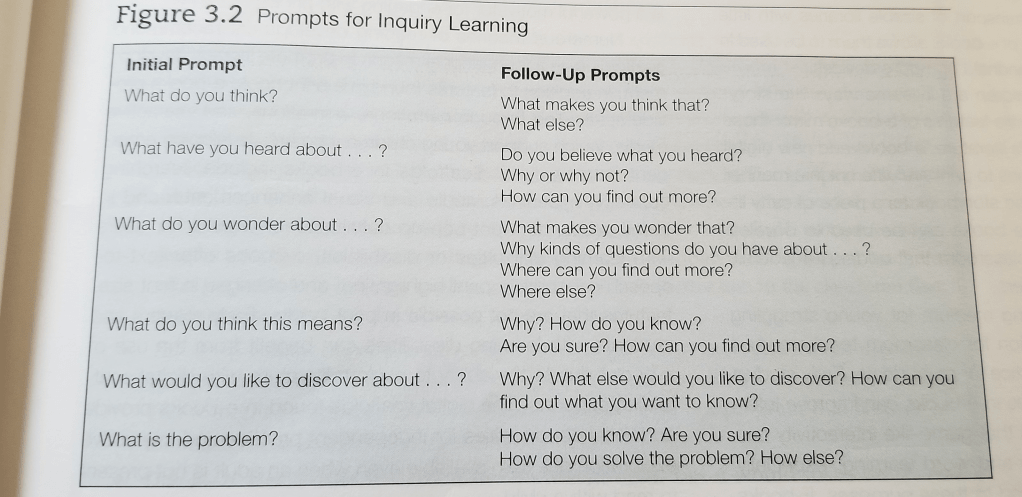
For Classroom Application of this chapter I really wanted to look into using prompts to assist students with further answering questions and deeper thinking. Generally, you do get a one or two word answer but I want students to start working on deeper meaning. Depending on my class size I think it would be fun to put students into small groups and let each of them read a selected passage from a book. I would have a list of “initial questions” that they would ask a classmate. Then once they answered I would have a list of “follow-up questions” for them to redirect at that classmate. I think it would be a fun interactive way to get them thinking deeper about the material we read. Then each group could compile a few of their deeper thinking outcomes to share with the entire class.
 virginiawilson