Running Records are one part of a 3 part process to place students in instructionally appropriate level texts. It also lets you know if you need to move a student up a level or not. They are most often used at the earlier stages of reading to monitor reading behavior and progress.
Part 1 – Use the 3 part assessment right away at the beginning of the school year to place students with appropriate texts. (Levels aa-J)
Assessment schedule: Do more frequently if not at expected rate for reading.
- Early Emergent Readers (Levels aa-C) 2-4 weeks
- Emergent Readers (Levels D-J) 4-6 weeks
- Early Fluent Readers (Levels K-P) 6-8 weeks
- Fluent Readers (Levels Q-Z) 8-10 weeks
Taking a Running Record:
- Select a benchmark passage/book that approximates students level. Explain they will read aloud while I observe
- Be close to student so I can watch students hand/eye finger movements
- While student reads, check appropriate symbols and markings on running record. Put a checkmark above words correctly read. IF something is read incorrectly, record what was said.
- IF the student is reading too fast/slow have them pause until I catch up.
- Pay attention to the readers behavior. Are they using meaning (M), Structural (S), and visual (V) cues to read words and gather meaning?
- Keep my mouth shut. Don’t talk unless I have too. Wait 5-10 seconds if student is stuck prior to telling them the word, explain it, then say try again.
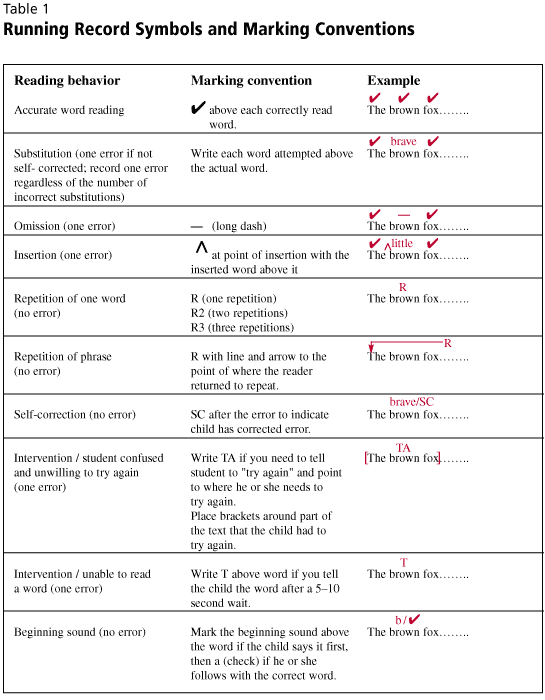
Marking a Running Record: Terms used when marking a running record –
- Errors (E): tallied during the reading – word substitutions, omits, inserts, has to be told, mispronounces a word.
- Self-correction (SC): when a child realizes his or her error and corrects it. Not scored as an error.
- Meaning (M): When a child takes cue to make sense of text by thinking about the background, info from pictures, or the meaning of a sentence. These cues assist in the reading of a word or phrase.
- Structure(S): refers to syntax. implicit knowledge of structure helps the reader know if what they read sounds correct.
- Visual (V): relates to the letters in a work and the word itself. A reader uses visual info when they study sound, word length, familiar word chunks and so on.
Two-Step Process:
- Mark the text on the running record form as the student reads the passage or book. Record their reading behavior.
- Fill in the boxes to the right of the lines of text marked. Begin by looking at any errors in the first line. See if there were any self-corrections. Mark those in the second box to the right of the line. Next determine whether the errors and self-corrections were made as a result of meaning, structure, or visual cueing. Write MSV in each box for error and a self-correction made and circle the appropriate letter for the cue used by the student.
- Use step 2 to total errors and self-corrections. Then calculate the student’s error rate, accuracy rate, and self-correction rate.

Scoring and Analyzing a Running Record: The information gathered while doing a running record is used to determine error, accuracy, and self-correction rates.
Qualitative analysis is used to make the observations that give us the MSV and along with fluency, intonation, and phrasing.
Error Rate: Total Words/Total Errors = Error Rate (ex. 99/12 = 12.38 or 12. ratio is 1:12)
Accuracy Rate: Total Words Read – Total Errors x 100 = Accuracy Rate (99-8)/99×100 = 91/99×100 = .919 x 100 = 91.9 or 92% accuracy rate
Accuracy Rate Chart:
- Independent (Easy enough for independent reading 95-100%)
- Instructional (Instructional level for use in leveled reading session 90-94%)
- Frustrational (Too difficult and will frustrate the reader 89% below)
Self-Correction Rate: (Number of errors + number of corrections / number of self-corrections = Self-Correction Rate) (ex. 8+3/3 = 11/3 = 3.666 or 4 rounded. 1:4 ratio, the child self-corrects 1 of every 4 errors.
Parts 2 &3 of 3-step assessment process:
2. Use retelling rubrics to identify strengths and weaknesses student may have comprehending texts; including analysis of text structures. Benchmark books also have multiple-choice comprehension quizzes and master keys to check strengths and weaknesses.
Scores
| Running Record | Quick Check Comprehension Quiz | Action |
|---|---|---|
| 95% + | 100% | Advance Student a Level |
| 95% + | 80% | Instruct at this Level |
| 95% + | <80% | Lower a Level, Assess Again |
| 90-94% | 80-100% | Instruct at this Level |
| 90-94% | <80% | Lower a Level, Assess Again |
| <90% | N/A | Lower a Level, Assess Again |
Use Benchmark WOWzers to reward students reading progress.
Through my beliefs about reading, I will often mirror units of language for instructional purposes. The smallest units of written language are letters, and the largest is the text itself. Included are paragraphs, sentences, words and lettes.
Curriculum: reflects what teachers and students do as they engage in classroom activity. This curriculum will be affected in 5 ways by a teachers beliefs about literacy and the decisions he or she makes-
- The instructional objectives or target the teacher emphasizes for the classroom literacy program.
- the materials the teacher selects and uses for instruction
- the learning environment the teacher perceives as most conducive to children’s development as readers and writers
- The practices, approaches, and instructional strategies the teacher uses to teach reading and writing
- the kinds of assessment the teacher perceives are best to evaluate literacy learning
Whole Language: a belief system that challenged the bottom-up perspective, was a progressive, child-centered movement that took root in the 60s. Since some words have irregularities, (ex shoe, vs foe, doe, toe) it was found to be better to focus on the whole word.
Conditions for Learning:
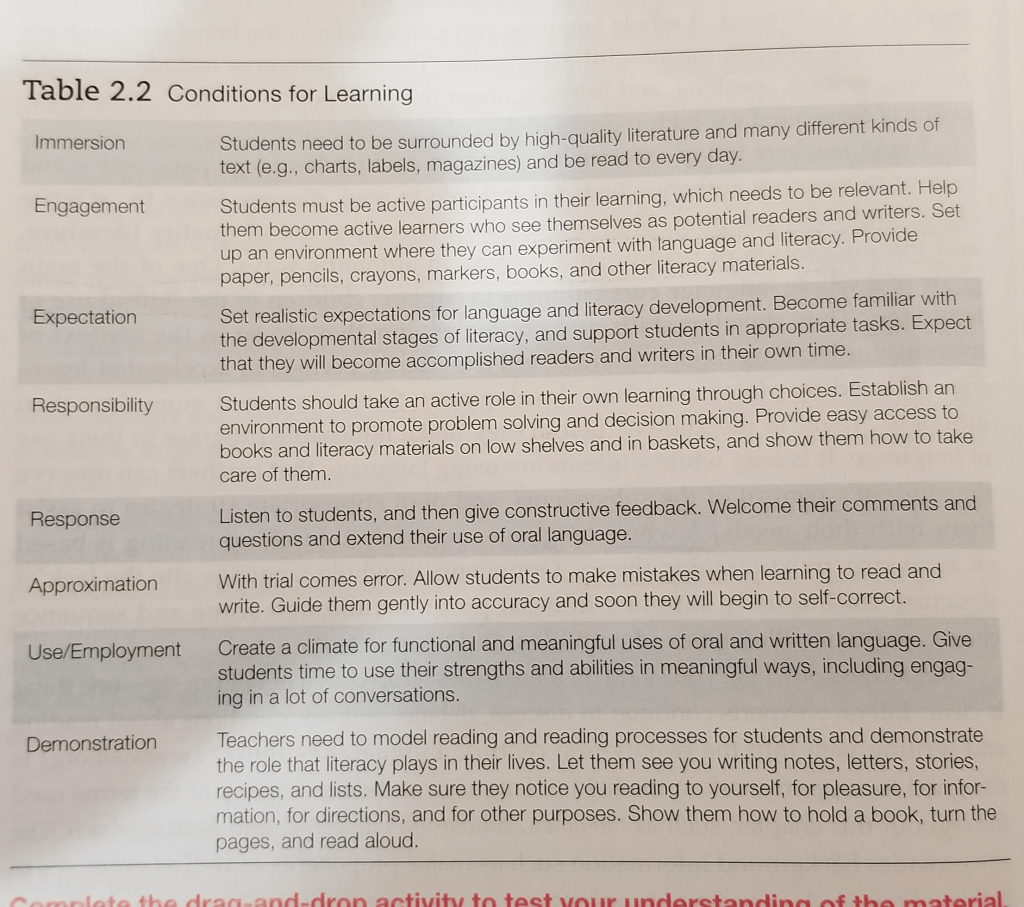
Different Instructional Approaches:
- Language-Experience Approach: includes planned and continuous activities such as individual and group dictated stories, the building of word banks of known words, creative writing activities, oral reading of prose and poetry by teacher and students, directed reading-thinking lessons, the investigation of interests using multiple materials, and keeping records of student progress. The main feature is that it embraces the natural language of children and uses their background experiences as the basis for learning to read.
- Literature-Based Instruction Approach: accommodate individual student differences in reading abilities and at the same time focus on meaning, interest, and enjoyment. In literature-based instruction, teachers encourage their students to select their own trade books for independent reading. (Teachers often hold conferences with individual students to ask questions about what they are reading, to make predictions, to discuss difficulties, or share interesting facts.)
- Technology-based Instruction: incorporates technology into the ways we locate, communicate, and disseminate information. Also changes our approach of how we read and write and become literate. Students have opportunities to videoconference with authors or other students, create video clips, movies, blogs, e-books, and online collaboration documents. (traditional basal packages now include ebooks that allow students to respond to questions, record verbal responses, highlight text, or take notes online)
- Individualizing Instruction: providing differentiated instruction to students. Two variations found today -(1)- individualized procedures are one part of the total program (ex. one day a week) or -(2)- parts of individualized reading are integrated into another reading approach (ex. self-selection during free reading). It really is a process of personalizing teaching to provide instruction that recognizes and responds to the unique learning needs of each child.
- The Integrate Approach: the best parts of all the approaches (included phonics, linguistic readers, basal programs, initial teaching alphabet, literature-based reading, language experience, and various grouping schemes and combinations of instruction.)
Explicit Strategy Instruction: directly teaching students what they need to know and providing opportunities for practice until the student applies the skill independently.
Instructional Scaffolding: the way teachers consistently check back in on students to see where more knowledge or practice needs to be applied prior to taking a step to the next level. This is done through formal and informal assessments.
Application: I would absolutely use an integrated approach with my students for reading. I think pulling from all the approaches to find what works best for each of them. I am a huge fan of using technology for teaching, and especially right now with COVID, it would be fun to let students read a book on their tablets. Then they could jot down some notes about the book or pin pages and we could bring it up on the projector so we could all talk about the different aspects of the book and what they read. Students who struggled could have a “help” button set up so it would play the word for them if they didn’t know it or couldn’t sound it out. I of course would also be walking around to assist. But I think it would be a fun way to do a group chat and incorporate in technology into literature.
 virginiawilson